Environmental Product Declaration Siplast Inc. 14911 Quorum Dr, Suite 600 | Dallas, TX 75254 | USA ph: 1 800 922-8800 Siplast.com NSF ConfidentialZIC System The Siplast story of uncompromising quality and commitment to our customers began over half a century ago. Since its origins in the late 1960s with the development of SBS-modified membranes, Siplast has expanded to polymethyl methacrylate (PMMA) liquid resins, lightweight insulating concretes, single-ply options and innovative products such as roof membranes surfaced with depolluting granules. Siplast has become an industry leader through a commitment to helping customers solve their toughest roofing and waterproofing challenges. For more information about Siplast, visit www.Siplast.com. The ZIC System combines the unique properties of lightweight insulating concrete and Insulperm premium expanded polystyrene foam insulation board. The ZIC mix consists of ZIC concrete aggregate and Portland cement. ZIC is used in new construction applications with slotted galvanized metal decking. ZIC System requires a 2-inch minimum thickness over the top of the insulation board. The ZIC System provides a solution to the difficulties presented by excessive moisture in structural lightweight concrete. This excessive moisture can affect the integrity and/or proper adhesion of roofing materials. Because the Siplast ZIC System is engineered to manage high moisture conditions without affecting the roof membrane or insulation system and can be applied directly to structural lightweight decks, ZIC presents an economical way to address the issue, as well help roofing application and construction sequencing. For additional information visit our product website: Product information
Environmental Product Declaration Siplast Inc. 14911 Quorum Dr, Suite 600 | Dallas, TX 75254 | USA ph: 1 800 922-8800 Siplast.com NSF ConfidentialINTERNAL EPD commissioner Siplast Company address 14911 Quorum Dr, Suite 600 Dallas, TX 75254 USA Product group Lightweight Insulating Concrete (LWIC) System Product name ZIC System Product intended use Insulating intermediate layer in commercial roof systems Product reference service life 75 years Reference standards ISO 14025, ISO 14040, ISO 14044, ISO 21930 EPD scope Cradle to Grave EPD number EPD10987 EPD date of validity July 16, 2024 EPD date of expiration July 16, 2029 EPD type Manufacturer specific Intended audience Business to Business Years of reported manufacturer data Three installations from 2018-2019 Functional unit One square meter of installed system with a thickness that gives an average thermal resistance RSI = 1 m2K/W (R-value 5.68 ft2°F-hr/Btu) and with a building service life of 75 years (packaging included) Applicable markets/regions North America LCA software and database version SimaPro 9.5 (2023), Ecoinvent 3.9.1, USLCI LCIA methodology and version number TRACI 2.1, IPCC AR5 Program administrator NSF Certification LLC 789 N. Dixboro, Ann Arbor, MI 48105 www. nsf.org Reference PCR and version number ISO 21930:2017 This declaration and its life cycle assessment was independently verified in accordance with ISO 14025: 2006, ISO 14040: 2006, 14044:2006, and 21930:2017. Type of review EXTERNAL Jack Geibig, Ecoform The reference life cycle assessment was conducted in accordance with ISO 14040, 14044, and 21930, by NSF: Jim Mellentine, jmellentine@nsf.org Disclaimer - This EPD was not written to support comparative assertions. EPDs based on different PCRs, or different calculation models, may not be comparable. When attempting to compare EPDs or life cycle impacts of products from different companies, the user should be aware of the uncertainty in the results due to and not limited to the practitioner’s assumptions, the source of the data used in the study and the software tool used to conduct the study. EPDs are comparable only if they comply with ISO 21930, use the same sub-category PCR where applicable, include all relevant information modules, apply a functional unit, and are based on equivalent scenarios with respect to the context of construction works.
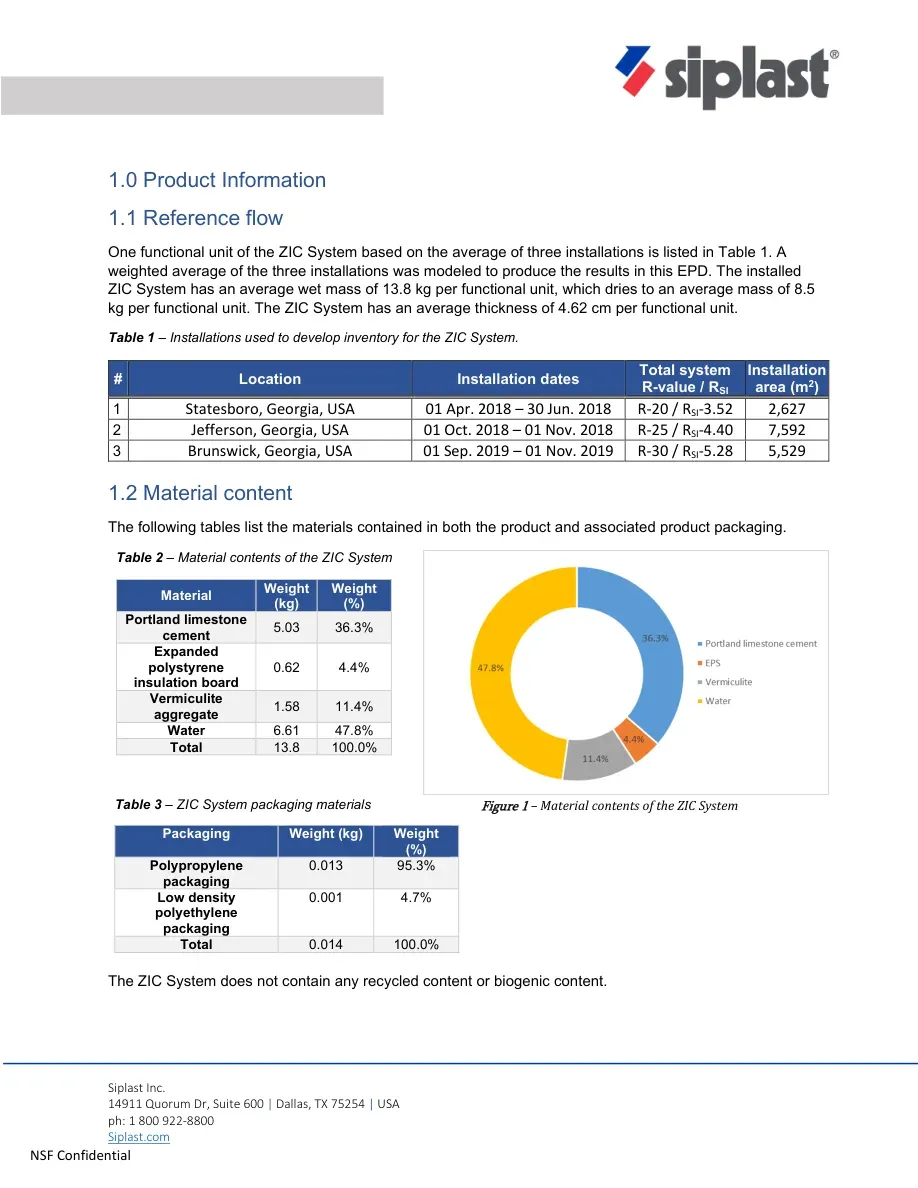
Environmental Product Declaration Siplast Inc. 14911 Quorum Dr, Suite 600 | Dallas, TX 75254 | USA ph: 1 800 922-8800 Siplast.com NSF Confidential1.0 Product Information 1.1 Reference flow One functional unit of the ZIC System based on the average of three installations is listed in Table 1. A weighted average of the three installations was modeled to produce the results in this EPD. The installed ZIC System has an average wet mass of 13.8 kg per functional unit, which dries to an average mass of 8.5 kg per functional unit. The ZIC System has an average thickness of 4.62 cm per functional unit. Table 1 – Installations used to develop inventory for the ZIC System. # Location Installation dates Total system R-value / RSI Installation area (m2) 1 Statesboro, Georgia, USA 01 Apr. 2018 – 30 Jun. 2018 R-20 / RSI-3.52 2,627 2 Jefferson, Georgia, USA 01 Oct. 2018 – 01 Nov. 2018 R-25 / RSI-4.40 7,592 3 Brunswick, Georgia, USA 01 Sep. 2019 – 01 Nov. 2019 R-30 / RSI-5.28 5,529 1.2 Material content The following tables list the materials contained in both the product and associated product packaging. Table 2 – Material contents of the ZIC System Material Weight (kg) Weight (%) Portland limestone cement 5.03 36.3% Expanded polystyrene insulation board 0.62 4.4% Vermiculite aggregate 1.58 11.4% Water 6.61 47.8% Total 13.8 100.0% Table 3 – ZIC System packaging materials Packaging Weight (kg) Weight (%) Polypropylene packaging 0.013 95.3% Low density polyethylene packaging 0.001 4.7% Total 0.014 100.0% The ZIC System does not contain any recycled content or biogenic content. Figure 1 – Material contents of the ZIC System
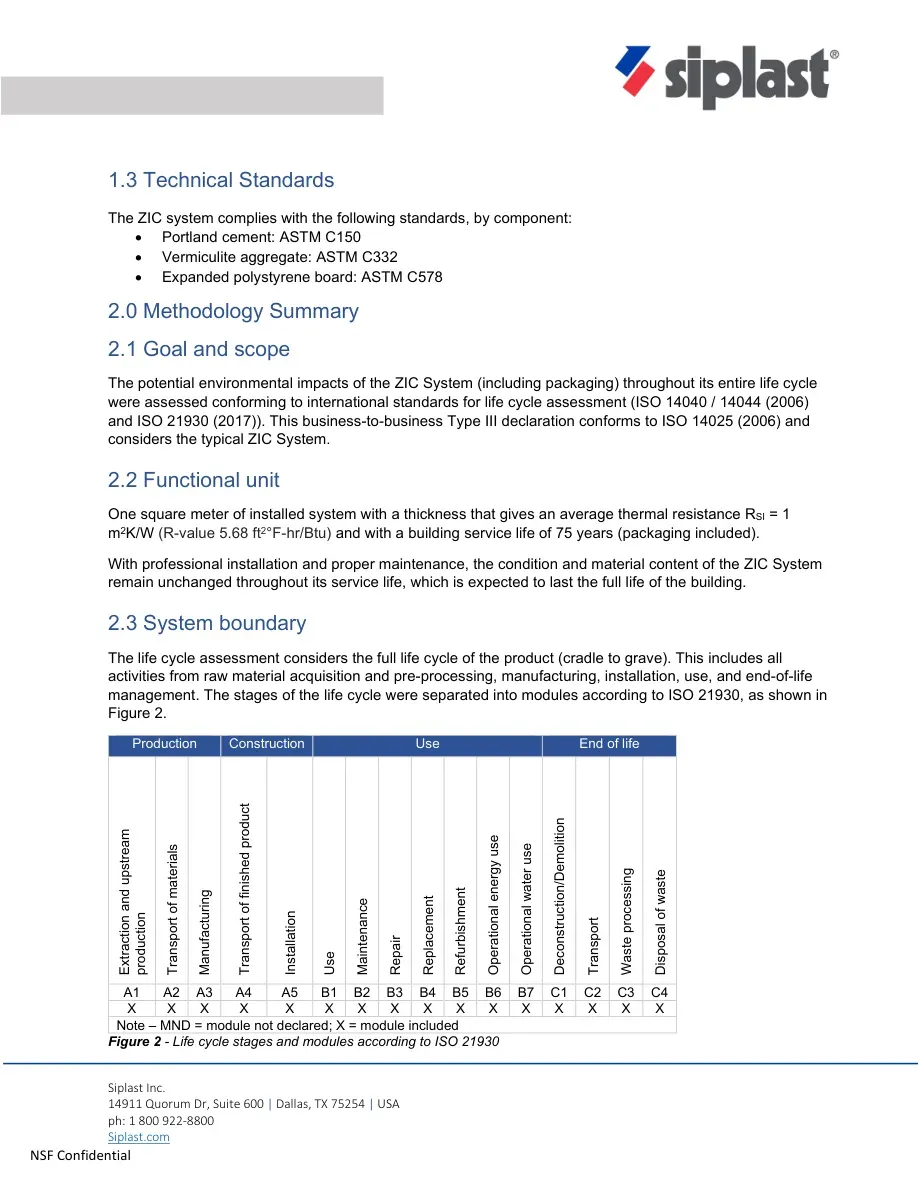
Environmental Product Declaration Siplast Inc. 14911 Quorum Dr, Suite 600 | Dallas, TX 75254 | USA ph: 1 800 922-8800 Siplast.com NSF Confidential1.3 Technical Standards The ZIC system complies with the following standards, by component: • Portland cement: ASTM C150 • Vermiculite aggregate: ASTM C332 • Expanded polystyrene board: ASTM C578 2.0 Methodology Summary 2.1 Goal and scope The potential environmental impacts of the ZIC System (including packaging) throughout its entire life cycle were assessed conforming to international standards for life cycle assessment (ISO 14040 / 14044 (2006) and ISO 21930 (2017)). This business-to-business Type III declaration conforms to ISO 14025 (2006) and considers the typical ZIC System. 2.2 Functional unit One square meter of installed system with a thickness that gives an average thermal resistance RSI = 1 m2K/W (R-value 5.68 ft2°F-hr/Btu) and with a building service life of 75 years (packaging included). With professional installation and proper maintenance, the condition and material content of the ZIC System remain unchanged throughout its service life, which is expected to last the full life of the building. 2.3 System boundary The life cycle assessment considers the full life cycle of the product (cradle to grave). This includes all activities from raw material acquisition and pre-processing, manufacturing, installation, use, and end-of-life management. The stages of the life cycle were separated into modules according to ISO 21930, as shown in Figure 2. Production Construction Use End of life Extraction and upstream production Transport of materials Manufacturing Transport of finished product Installation Use Maintenance Repair Replacement Refurbishment Operational energy use Operational water use Deconstruction/Demolition Transport Waste processing Disposal of waste A1 A2 A3 A4 A5 B1 B2 B3 B4 B5 B6 B7 C1 C2 C3 C4 X X X X X X X X X X X X X X X X Note – MND = module not declared; X = module included Figure 2 - Life cycle stages and modules according to ISO 21930
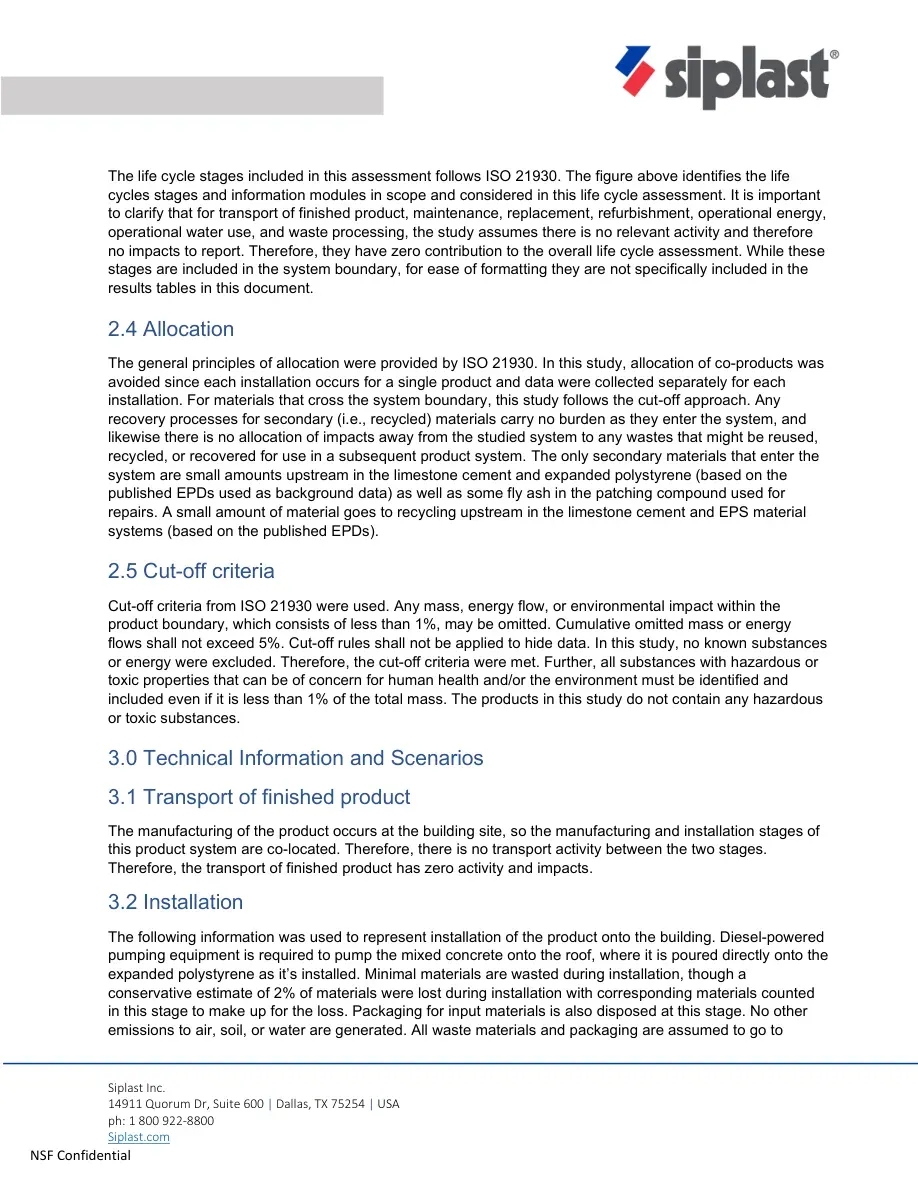
Environmental Product Declaration Siplast Inc. 14911 Quorum Dr, Suite 600 | Dallas, TX 75254 | USA ph: 1 800 922-8800 Siplast.com NSF ConfidentialThe life cycle stages included in this assessment follows ISO 21930. The figure above identifies the life cycles stages and information modules in scope and considered in this life cycle assessment. It is important to clarify that for transport of finished product, maintenance, replacement, refurbishment, operational energy, operational water use, and waste processing, the study assumes there is no relevant activity and therefore no impacts to report. Therefore, they have zero contribution to the overall life cycle assessment. While these stages are included in the system boundary, for ease of formatting they are not specifically included in the results tables in this document. 2.4 Allocation The general principles of allocation were provided by ISO 21930. In this study, allocation of co-products was avoided since each installation occurs for a single product and data were collected separately for each installation. For materials that cross the system boundary, this study follows the cut-off approach. Any recovery processes for secondary (i.e., recycled) materials carry no burden as they enter the system, and likewise there is no allocation of impacts away from the studied system to any wastes that might be reused, recycled, or recovered for use in a subsequent product system. The only secondary materials that enter the system are small amounts upstream in the limestone cement and expanded polystyrene (based on the published EPDs used as background data) as well as some fly ash in the patching compound used for repairs. A small amount of material goes to recycling upstream in the limestone cement and EPS material systems (based on the published EPDs). 2.5 Cut-off criteria Cut-off criteria from ISO 21930 were used. Any mass, energy flow, or environmental impact within the product boundary, which consists of less than 1%, may be omitted. Cumulative omitted mass or energy flows shall not exceed 5%. Cut-off rules shall not be applied to hide data. In this study, no known substances or energy were excluded. Therefore, the cut-off criteria were met. Further, all substances with hazardous or toxic properties that can be of concern for human health and/or the environment must be identified and included even if it is less than 1% of the total mass. The products in this study do not contain any hazardous or toxic substances. 3.0 Technical Information and Scenarios 3.1 Transport of finished product The manufacturing of the product occurs at the building site, so the manufacturing and installation stages of this product system are co-located. Therefore, there is no transport activity between the two stages. Therefore, the transport of finished product has zero activity and impacts. 3.2 Installation The following information was used to represent installation of the product onto the building. Diesel-powered pumping equipment is required to pump the mixed concrete onto the roof, where it is poured directly onto the expanded polystyrene as it’s installed. Minimal materials are wasted during installation, though a conservative estimate of 2% of materials were lost during installation with corresponding materials counted in this stage to make up for the loss. Packaging for input materials is also disposed at this stage. No other emissions to air, soil, or water are generated. All waste materials and packaging are assumed to go to
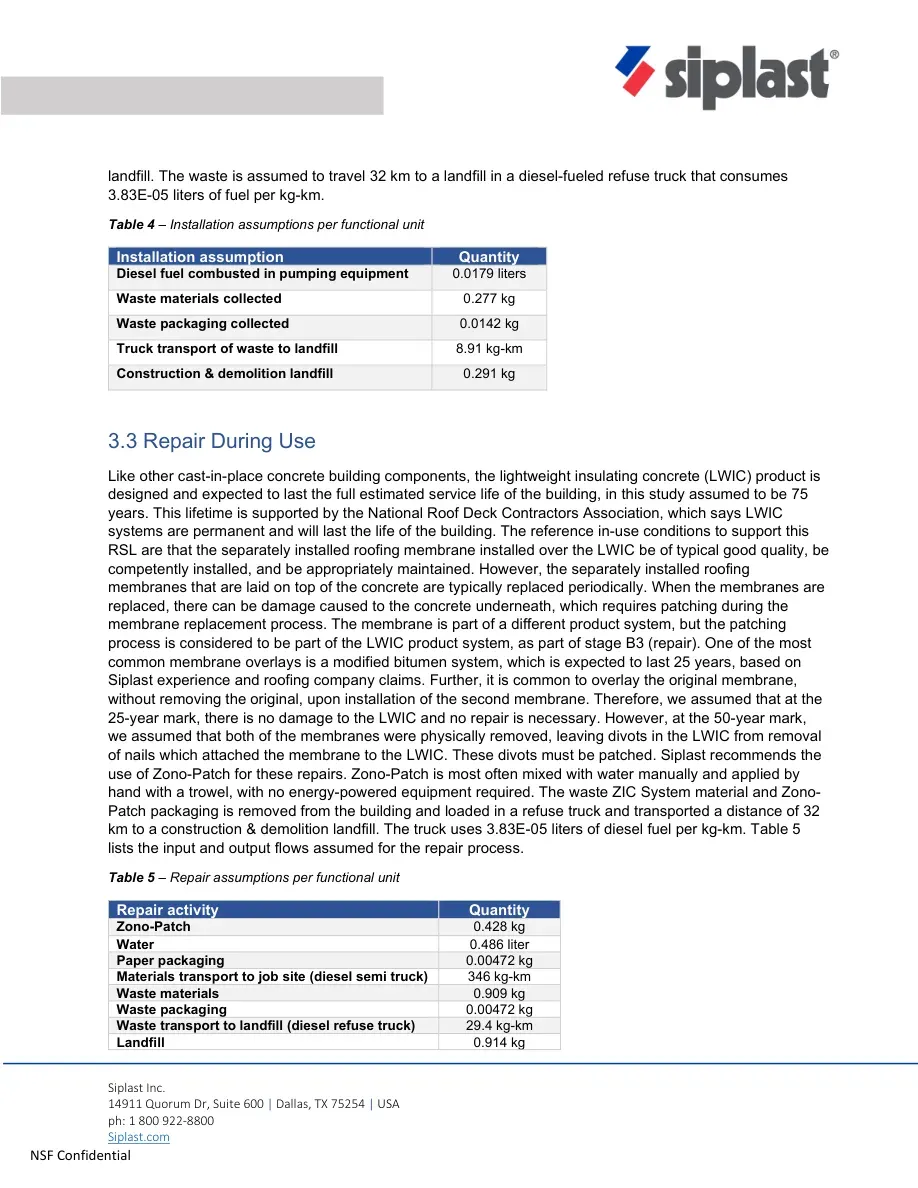
Environmental Product Declaration Siplast Inc. 14911 Quorum Dr, Suite 600 | Dallas, TX 75254 | USA ph: 1 800 922-8800 Siplast.com NSF Confidentiallandfill. The waste is assumed to travel 32 km to a landfill in a diesel-fueled refuse truck that consumes 3.83E-05 liters of fuel per kg-km. Table 4 – Installation assumptions per functional unit Installation assumption Quantity Diesel fuel combusted in pumping equipment 0.0179 liters Waste materials collected 0.277 kg Waste packaging collected 0.0142 kg Truck transport of waste to landfill 8.91 kg-km Construction & demolition landfill 0.291 kg 3.3 Repair During Use Like other cast-in-place concrete building components, the lightweight insulating concrete (LWIC) product is designed and expected to last the full estimated service life of the building, in this study assumed to be 75 years. This lifetime is supported by the National Roof Deck Contractors Association, which says LWIC systems are permanent and will last the life of the building. The reference in-use conditions to support this RSL are that the separately installed roofing membrane installed over the LWIC be of typical good quality, be competently installed, and be appropriately maintained. However, the separately installed roofing membranes that are laid on top of the concrete are typically replaced periodically. When the membranes are replaced, there can be damage caused to the concrete underneath, which requires patching during the membrane replacement process. The membrane is part of a different product system, but the patching process is considered to be part of the LWIC product system, as part of stage B3 (repair). One of the most common membrane overlays is a modified bitumen system, which is expected to last 25 years, based on Siplast experience and roofing company claims. Further, it is common to overlay the original membrane, without removing the original, upon installation of the second membrane. Therefore, we assumed that at the 25-year mark, there is no damage to the LWIC and no repair is necessary. However, at the 50-year mark, we assumed that both of the membranes were physically removed, leaving divots in the LWIC from removal of nails which attached the membrane to the LWIC. These divots must be patched. Siplast recommends the use of Zono-Patch for these repairs. Zono-Patch is most often mixed with water manually and applied by hand with a trowel, with no energy-powered equipment required. The waste ZIC System material and Zono-Patch packaging is removed from the building and loaded in a refuse truck and transported a distance of 32 km to a construction & demolition landfill. The truck uses 3.83E-05 liters of diesel fuel per kg-km. Table 5 lists the input and output flows assumed for the repair process. Table 5 – Repair assumptions per functional unit Repair activity Quantity Zono-Patch 0.428 kg Water 0.486 liter Paper packaging 0.00472 kg Materials transport to job site (diesel semi truck) 346 kg-km Waste materials 0.909 kg Waste packaging 0.00472 kg Waste transport to landfill (diesel refuse truck) 29.4 kg-km Landfill 0.914 kg
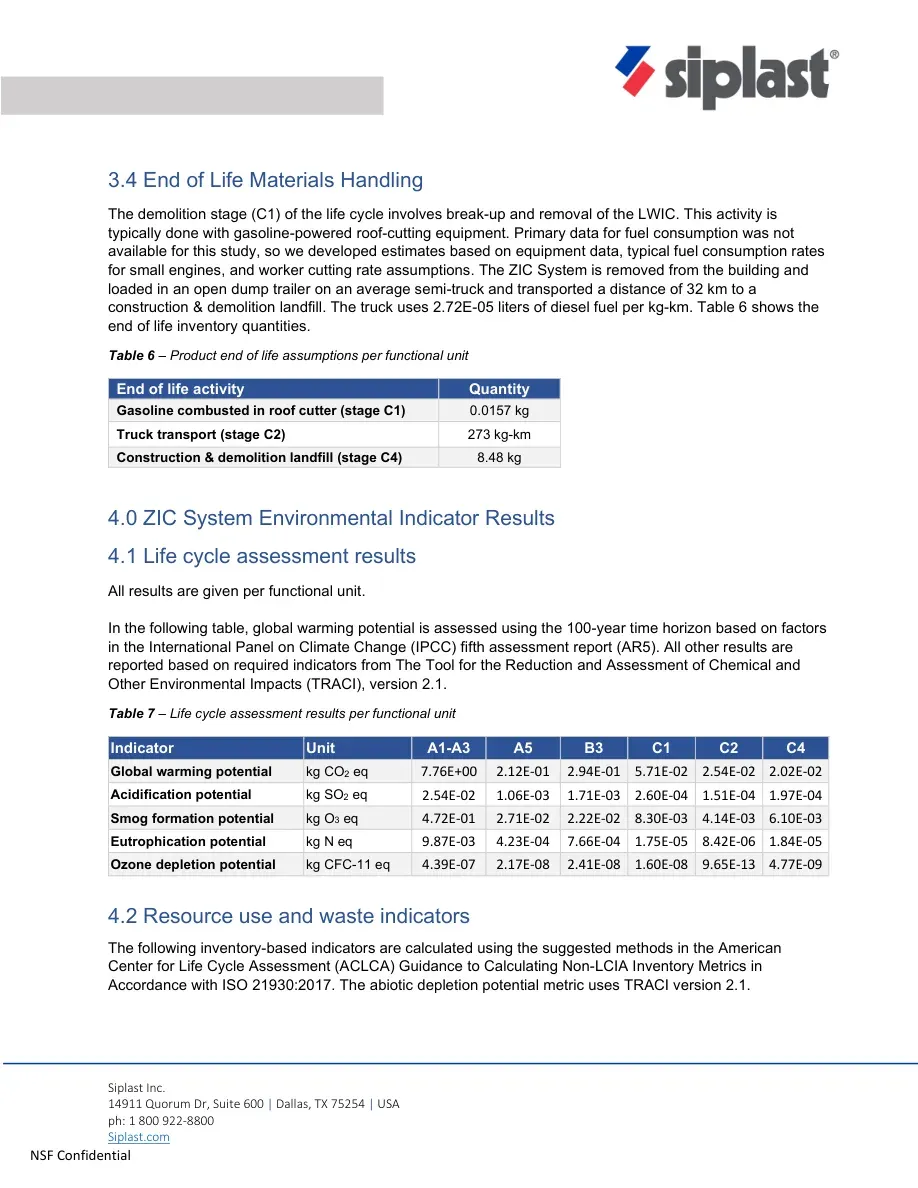
Environmental Product Declaration Siplast Inc. 14911 Quorum Dr, Suite 600 | Dallas, TX 75254 | USA ph: 1 800 922-8800 Siplast.com NSF Confidential3.4 End of Life Materials Handling The demolition stage (C1) of the life cycle involves break-up and removal of the LWIC. This activity is typically done with gasoline-powered roof-cutting equipment. Primary data for fuel consumption was not available for this study, so we developed estimates based on equipment data, typical fuel consumption rates for small engines, and worker cutting rate assumptions. The ZIC System is removed from the building and loaded in an open dump trailer on an average semi-truck and transported a distance of 32 km to a construction & demolition landfill. The truck uses 2.72E-05 liters of diesel fuel per kg-km. Table 6 shows the end of life inventory quantities. Table 6 – Product end of life assumptions per functional unit End of life activity Quantity Gasoline combusted in roof cutter (stage C1) 0.0157 kg Truck transport (stage C2) 273 kg-km Construction & demolition landfill (stage C4) 8.48 kg 4.0 ZIC System Environmental Indicator Results 4.1 Life cycle assessment results All results are given per functional unit. In the following table, global warming potential is assessed using the 100-year time horizon based on factors in the International Panel on Climate Change (IPCC) fifth assessment report (AR5). All other results are reported based on required indicators from The Tool for the Reduction and Assessment of Chemical and Other Environmental Impacts (TRACI), version 2.1. Table 7 – Life cycle assessment results per functional unit Indicator Unit A1-A3 A5 B3 C1 C2 C4 Global warming potential kg CO2 eq 7.76E+00 2.12E-01 2.94E-01 5.71E-02 2.54E-02 2.02E-02 Acidification potential kg SO2 eq 2.54E-02 1.06E-03 1.71E-03 2.60E-04 1.51E-04 1.97E-04 Smog formation potential kg O3 eq 4.72E-01 2.71E-02 2.22E-02 8.30E-03 4.14E-03 6.10E-03 Eutrophication potential kg N eq 9.87E-03 4.23E-04 7.66E-04 1.75E-05 8.42E-06 1.84E-05 Ozone depletion potential kg CFC-11 eq 4.39E-07 2.17E-08 2.41E-08 1.60E-08 9.65E-13 4.77E-09 4.2 Resource use and waste indicators The following inventory-based indicators are calculated using the suggested methods in the American Center for Life Cycle Assessment (ACLCA) Guidance to Calculating Non-LCIA Inventory Metrics in Accordance with ISO 21930:2017. The abiotic depletion potential metric uses TRACI version 2.1.
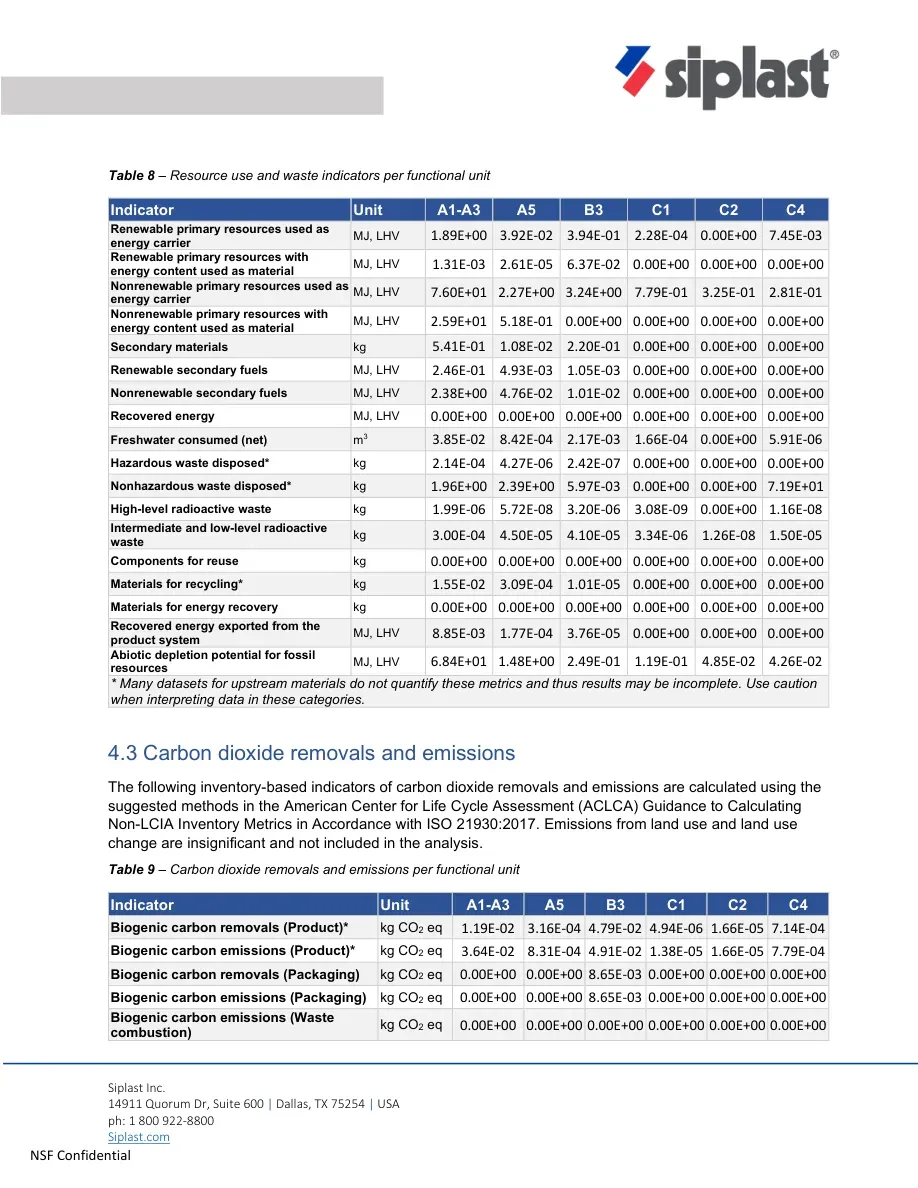
Environmental Product Declaration Siplast Inc. 14911 Quorum Dr, Suite 600 | Dallas, TX 75254 | USA ph: 1 800 922-8800 Siplast.com NSF ConfidentialTable 8 – Resource use and waste indicators per functional unit Indicator Unit A1-A3 A5 B3 C1 C2 C4 Renewable primary resources used as energy carrier MJ, LHV 1.89E+00 3.92E-02 3.94E-01 2.28E-04 0.00E+00 7.45E-03 Renewable primary resources with energy content used as material MJ, LHV 1.31E-03 2.61E-05 6.37E-02 0.00E+00 0.00E+00 0.00E+00 Nonrenewable primary resources used as energy carrier MJ, LHV 7.60E+01 2.27E+00 3.24E+00 7.79E-01 3.25E-01 2.81E-01 Nonrenewable primary resources with energy content used as material MJ, LHV 2.59E+01 5.18E-01 0.00E+00 0.00E+00 0.00E+00 0.00E+00 Secondary materials kg 5.41E-01 1.08E-02 2.20E-01 0.00E+00 0.00E+00 0.00E+00 Renewable secondary fuels MJ, LHV 2.46E-01 4.93E-03 1.05E-03 0.00E+00 0.00E+00 0.00E+00 Nonrenewable secondary fuels MJ, LHV 2.38E+00 4.76E-02 1.01E-02 0.00E+00 0.00E+00 0.00E+00 Recovered energy MJ, LHV 0.00E+00 0.00E+00 0.00E+00 0.00E+00 0.00E+00 0.00E+00 Freshwater consumed (net) m3 3.85E-02 8.42E-04 2.17E-03 1.66E-04 0.00E+00 5.91E-06 Hazardous waste disposed* kg 2.14E-04 4.27E-06 2.42E-07 0.00E+00 0.00E+00 0.00E+00 Nonhazardous waste disposed* kg 1.96E+00 2.39E+00 5.97E-03 0.00E+00 0.00E+00 7.19E+01 High-level radioactive waste kg 1.99E-06 5.72E-08 3.20E-06 3.08E-09 0.00E+00 1.16E-08 Intermediate and low-level radioactive waste kg 3.00E-04 4.50E-05 4.10E-05 3.34E-06 1.26E-08 1.50E-05 Components for reuse kg 0.00E+00 0.00E+00 0.00E+00 0.00E+00 0.00E+00 0.00E+00 Materials for recycling* kg 1.55E-02 3.09E-04 1.01E-05 0.00E+00 0.00E+00 0.00E+00 Materials for energy recovery kg 0.00E+00 0.00E+00 0.00E+00 0.00E+00 0.00E+00 0.00E+00 Recovered energy exported from the product system MJ, LHV 8.85E-03 1.77E-04 3.76E-05 0.00E+00 0.00E+00 0.00E+00 Abiotic depletion potential for fossil resources MJ, LHV 6.84E+01 1.48E+00 2.49E-01 1.19E-01 4.85E-02 4.26E-02 * Many datasets for upstream materials do not quantify these metrics and thus results may be incomplete. Use caution when interpreting data in these categories. 4.3 Carbon dioxide removals and emissions The following inventory-based indicators of carbon dioxide removals and emissions are calculated using the suggested methods in the American Center for Life Cycle Assessment (ACLCA) Guidance to Calculating Non-LCIA Inventory Metrics in Accordance with ISO 21930:2017. Emissions from land use and land use change are insignificant and not included in the analysis. Table 9 – Carbon dioxide removals and emissions per functional unit Indicator Unit A1-A3 A5 B3 C1 C2 C4 Biogenic carbon removals (Product)* kg CO2 eq 1.19E-02 3.16E-04 4.79E-02 4.94E-06 1.66E-05 7.14E-04 Biogenic carbon emissions (Product)* kg CO2 eq 3.64E-02 8.31E-04 4.91E-02 1.38E-05 1.66E-05 7.79E-04 Biogenic carbon removals (Packaging) kg CO2 eq 0.00E+00 0.00E+00 8.65E-03 0.00E+00 0.00E+00 0.00E+00 Biogenic carbon emissions (Packaging) kg CO2 eq 0.00E+00 0.00E+00 8.65E-03 0.00E+00 0.00E+00 0.00E+00 Biogenic carbon emissions (Waste combustion) kg CO2 eq 0.00E+00 0.00E+00 0.00E+00 0.00E+00 0.00E+00 0.00E+00
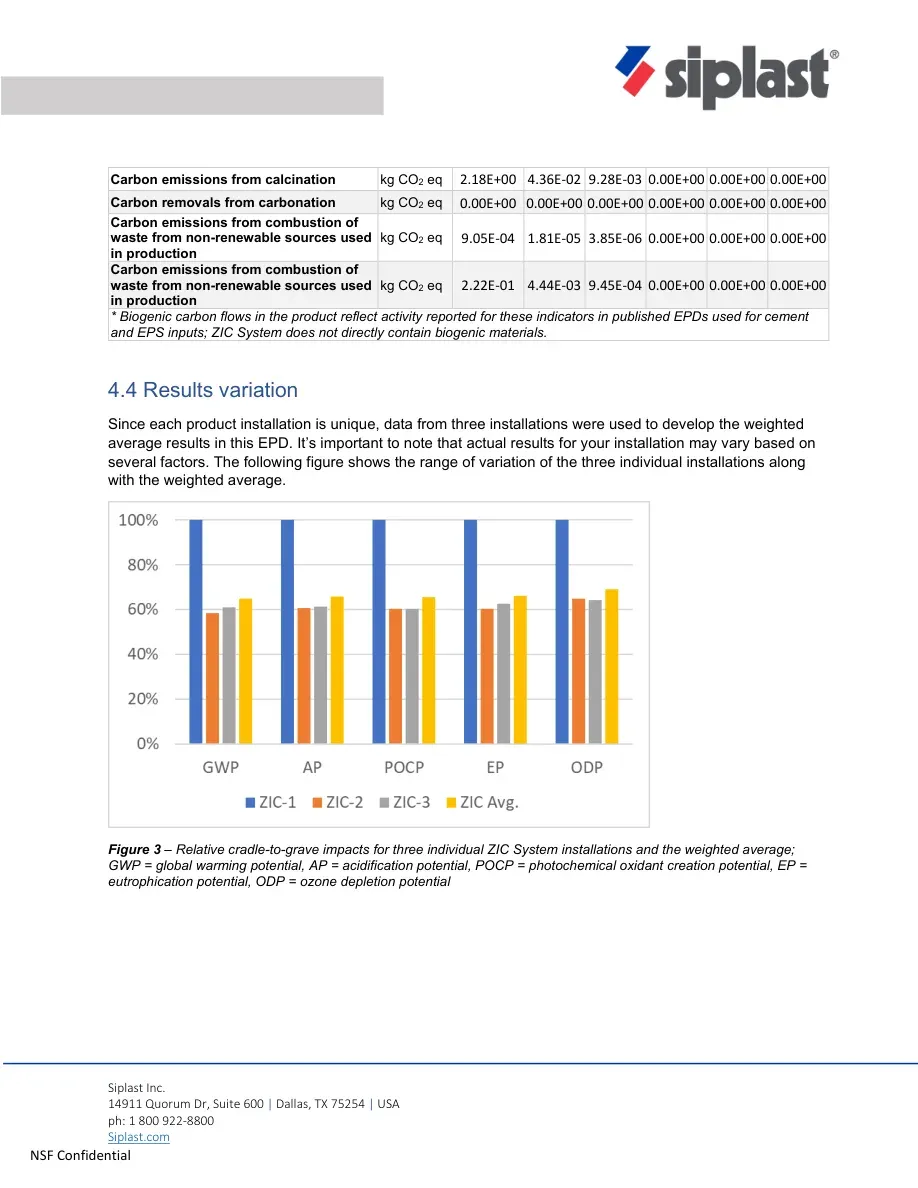
Environmental Product Declaration Siplast Inc. 14911 Quorum Dr, Suite 600 | Dallas, TX 75254 | USA ph: 1 800 922-8800 Siplast.com NSF ConfidentialCarbon emissions from calcination kg CO2 eq 2.18E+00 4.36E-02 9.28E-03 0.00E+00 0.00E+00 0.00E+00 Carbon removals from carbonation kg CO2 eq 0.00E+00 0.00E+00 0.00E+00 0.00E+00 0.00E+00 0.00E+00 Carbon emissions from combustion of waste from non-renewable sources used in production kg CO2 eq 9.05E-04 1.81E-05 3.85E-06 0.00E+00 0.00E+00 0.00E+00 Carbon emissions from combustion of waste from non-renewable sources used in production kg CO2 eq 2.22E-01 4.44E-03 9.45E-04 0.00E+00 0.00E+00 0.00E+00 * Biogenic carbon flows in the product reflect activity reported for these indicators in published EPDs used for cement and EPS inputs; ZIC System does not directly contain biogenic materials. 4.4 Results variation Since each product installation is unique, data from three installations were used to develop the weighted average results in this EPD. It’s important to note that actual results for your installation may vary based on several factors. The following figure shows the range of variation of the three individual installations along with the weighted average. Figure 3 – Relative cradle-to-grave impacts for three individual ZIC System installations and the weighted average; GWP = global warming potential, AP = acidification potential, POCP = photochemical oxidant creation potential, EP = eutrophication potential, ODP = ozone depletion potential
Environmental Product Declaration Siplast Inc. 14911 Quorum Dr, Suite 600 | Dallas, TX 75254 | USA ph: 1 800 922-8800 Siplast.com NSF Confidential5.0 Additional Environmental Information – Building Use-Stage Benefits Demonstration Summary Lightweight Insulating Concrete’s low thermal conductivity reduces energy consumption during a building’s operation by reducing the associated environmental impacts of energy use. Quantifying the reduction in energy use for heating, cooling, and ventilating for a specific building use category and construction type that includes LWIC as part of the roof system can be modeled relative to a baseline design to demonstrate the energy saving benefits. Roof Replacement Background Reroofing of an existing commercial or industrial building is a common practice over its service life. Roof replacement or roof re-cover are the two distinct methods used when reroofing. This framework models a 25-year roof service life for each roof installation, presuming re-covering of the roofing membrane at year 25 and replacement of the roofing membrane at year 50 of the building’s predicted 75-year service life. The LWIC remains in place over the 75 year service life with minimal repair to its top surface to allow for new roof membrane installation at year 50. The framework of this EPD conservatively presumes removal of the LWIC at year 75.
Environmental Product Declaration Siplast Inc. 14911 Quorum Dr, Suite 600 | Dallas, TX 75254 | USA ph: 1 800 922-8800 Siplast.com NSF Confidential6.0 References ACLCA. (2019). Guidance to calculate non-LCIA inventory metrics in accordance with ISO 21930:2017. American Center for Life Cycle Assessment. Retrieved from https://aclca.org/wp-content/uploads/ISO-21930-Final.pdf Bare, J. (2011). TRACI 2.1: The Tool for the Reduction and Assessment of Chemical and Other Environmental Impacts 2.1. Clean Technologies and Environmental Policy, 13, 687-696. International Panel on Climate Change. Fifth Assessment Report. 2013. Retrieved from https://www.ipcc.ch/assessment-report/ar5/. ISO 14025. (2006). ISO 14025 (2006) Environmental labels and declarations - Type III environmental declarations Principles and Procedures. Geneva, Switzerland: International Organization for Standardization. ISO 14040. (2006). ISO 14040 (2006): Environmental Management -- Life Cycle Assessment - Principles and Framework. Geneva, Switzerland: International Organization for Standardization. ISO 14044. (2006). ISO 14044 (2006): Environmental Management - Life Cycle Assessment - Requirements and Guidelines. Geneva, Switzerland: International Organization for Standardization. ISO 14044 Amd 1. (2017). ISO 14044:2016/ Amd 1:2017 Environment al management - Life cycle assessment - Requirements and Guidelines - Amendment 1. Geneva, Switzerland: International Organization for Standardization. ISO 21930. (2017). ISO 21930:2017 Sustainability in buildings and civil engineering works - Core rules for environmental product declarations of construction products and services. Geneva, Switzerland: International Organization for Standardization. National Roof Deck Contractors Association. Lightweight Insulating Concrete website. Retrieved from https://nrdca.org/roof-deck-system/lightweight-insulating-concrete NSF. Life Cycle Assessment of Siplast’s NVS, ZIC, and Insulcel Lightweight Insulating Concrete Systems. July 2024. SimaPro. (2023). SimaPro LCA Software. Developed by PRe Sustainability. Version 9.5. Amersvoort, The Netherlands. US EPA. (2018). United States Environmental Protection Agency (EPA). Advancing Sustainable Materials Management: Facts and Figures Report. Retrieved from https://www.epa.gov/facts-and-figures-about-materials-waste-and-recycling/advancing-sustainable-materials-management US EPA. (2019). United States Environmental Protection Agency (EPA) Waste Reduction Model (WARM). Retrieved from https://www.epa.gov/warm US Life Cycle Inventory Database. (2012). National Renewable Energy Laboratory, 2012. Retrieved from https://www.lcacommons.gov/nrel/search Wernet, G., Bauer, C., Steubing, B., Reinhard, J., Moreno-Ruiz, E., & Weidema, B. (2016). The ecoinvent database version 3 (part I): overview and methodology. The International Journal of Life Cycle Assessment, 21(9), 1218-1230. Retrieved June 16, 2020, from http://link.springer.com/10.1007/s11367-016-1087-8
