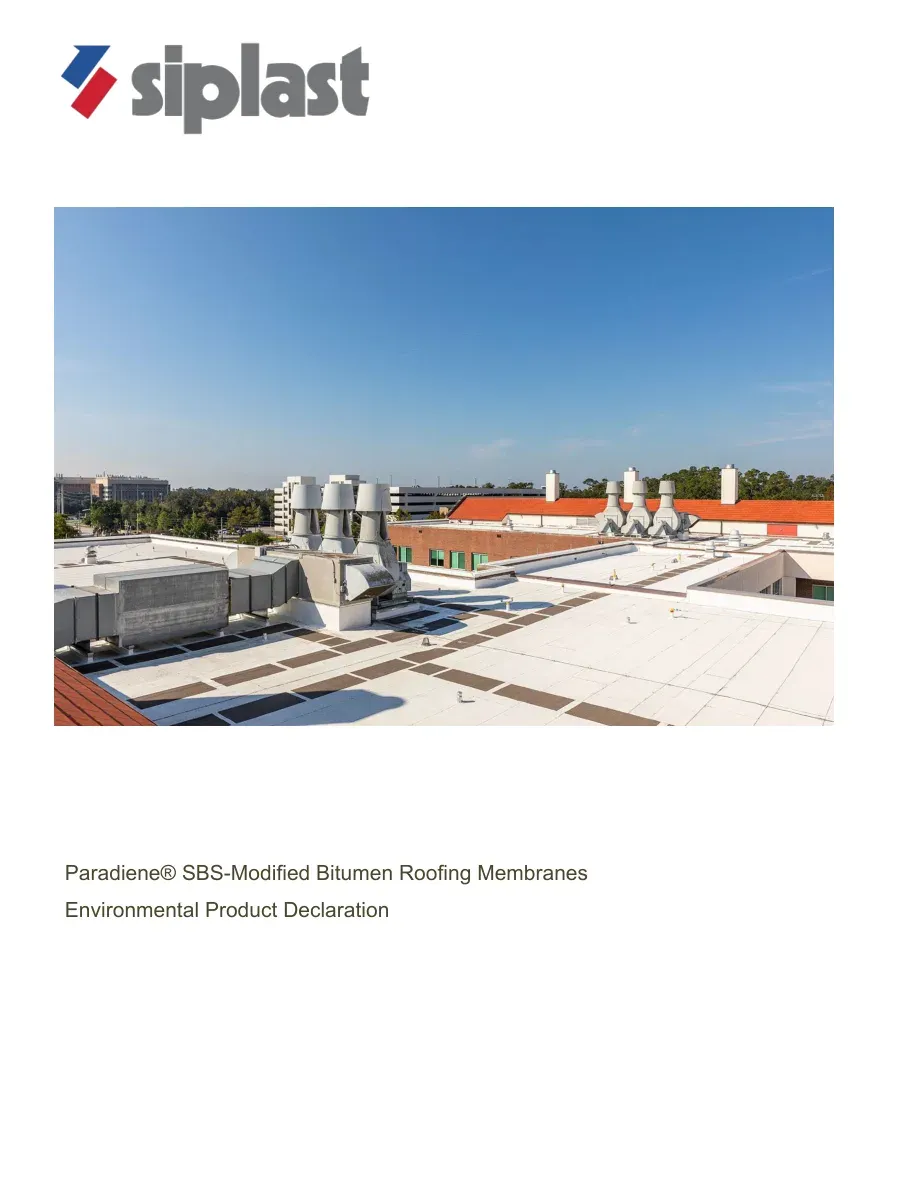
Paradiene® SBS-Modified Bitumen Roofing Membranes Environmental Product Declaration
1.0 Content of the EPD Program Operator NSF Certification, LLC 789 N. Dixboro Ann Arbor, MI 48105 www.nsf.org General Program Instructions and Version Number Part A: Life Cycle Assessment Calculation Rules and Report Requirements, Version 3.2 December 2018 Manufacturer Name and Address Siplast 14911 Quorum, Suite 600 Dallas, TX 75254 Declaration Number EPD10745 Declared Product and Declared Unit Paradiene® SBS-Modified Bitumen Roofing Membranes Declared Unit: 1 m2 Reference PCR and Version Number UL Part A: Life Cycle Assessment Calculation Rules and Report Requirements, v3.2 December 2018 UL Part B: Asphalt Shingles, Built-up Asphalt Membrane Roofing and Modified Bituminous Membrane Roofing v2.0 July 2019 Product’s Intended Application and Use Roofing Product RSL N/A Markets of Applicability North America Date of Issue July 26, 2022 Period of Validity 5 years EPD Type Product-specific Range of Dataset Variability N/A EPD Scope Cradle-to-gate with options (A1-A5, C1-C4) Year of Reported Manufacturer Primary Data 2020 LCA Software and Version Number SimaPro v9.1.1.1 LCI Database and Version Number ecoinvent v3.5 LCIA Methodology and Version Number TRACI 2.1 CML 2001-Jan 2016 The sub-category PCR Review was conducted by: Tom Gloria, Chair Industrial Ecology Consultants t.gloria@industrial-ecology.comJim Mellentine Ramboll Environment JMellentine@ramboll.com Eric Blond eric@ericblond.com This declaration was independently verified in accordance with ISO 14025: 2006. The UL Environment “Part A: Calculation Rules for the Life Cycle Assessment and Requirements on the Project Report,” v3.2 (December 2018), in conformance with ISO 21930:2017, serves as the core PCR, with additional considerations from the USGBC/UL Environment Part A Enhancement (2017) ☐INTERNAL EXTERNAL Tony Favilla, NSF Certification, LLC afavilla@nsf.org This life cycle assessment was conducted in accordance with ISO 14044 and the reference PCR by: Sustainable Solutions Corporation This life cycle assessment was independently verified in accordance with ISO 14044 and the reference PCR by: Jack Geibig, EcoForm, LLC jgeibig@ecoform.com Limitations: Environmental declarations from different programs (ISO 14025) may not be comparable. Comparison of the environmental performance using EPD information shall consider all relevant information modules over the full life cycle of the products within the building. This PCR allows EPD comparability only when the same functional requirements between products are ensured and the requirements of ISO 21930:2017 §5.5 are met. It should be noted that different LCA software and background LCI datasets may lead to differences results for upstream or downstream of the life cycle stages declared.
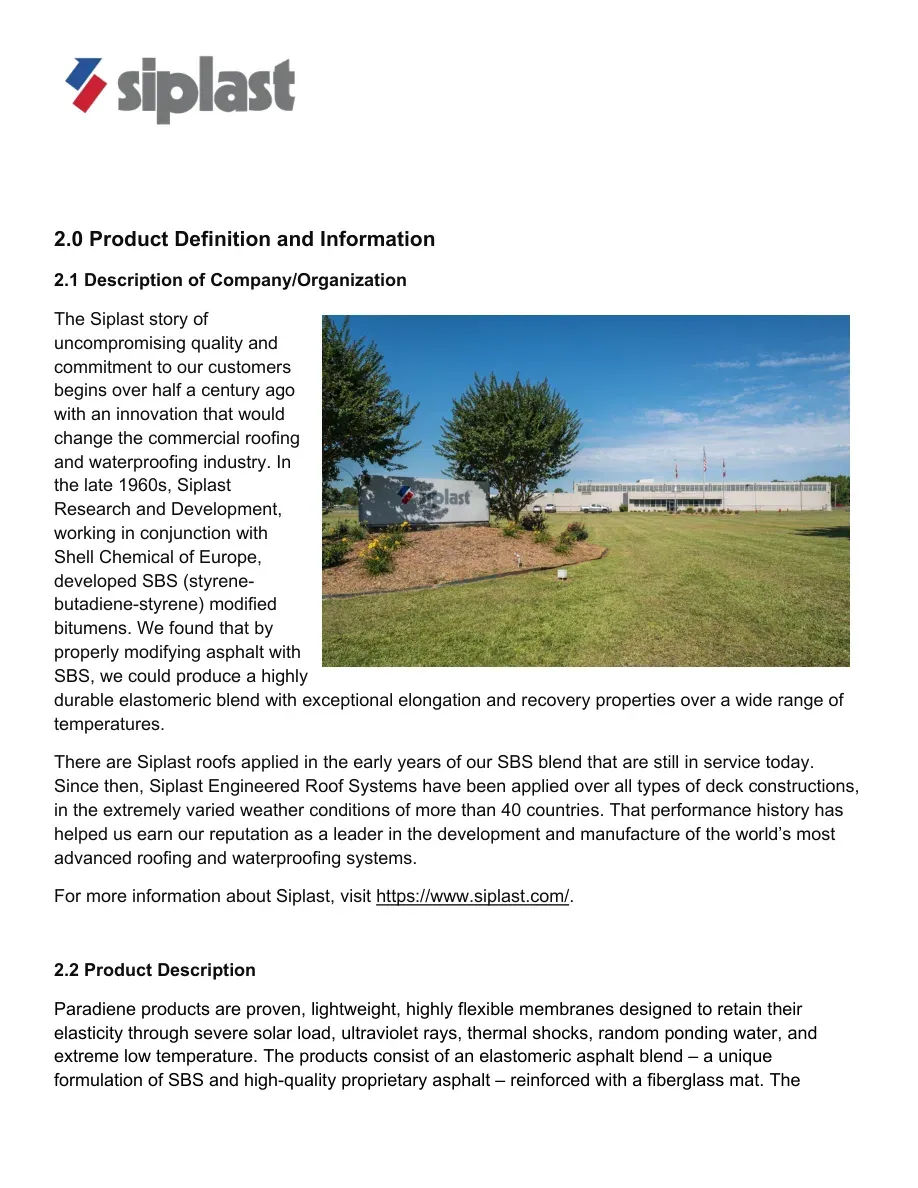
2.0 Product Definition and Information 2.1 Description of Company/Organization The Siplast story of uncompromising quality and commitment to our customers begins over half a century ago with an innovation that would change the commercial roofing and waterproofing industry. In the late 1960s, Siplast Research and Development, working in conjunction with Shell Chemical of Europe, developed SBS (styrene-butadiene-styrene) modified bitumens. We found that by properly modifying asphalt with SBS, we could produce a highly durable elastomeric blend with exceptional elongation and recovery properties over a wide range of temperatures. There are Siplast roofs applied in the early years of our SBS blend that are still in service today. Since then, Siplast Engineered Roof Systems have been applied over all types of deck constructions, in the extremely varied weather conditions of more than 40 countries. That performance history has helped us earn our reputation as a leader in the development and manufacture of the world’s most advanced roofing and waterproofing systems. For more information about Siplast, visit https://www.siplast.com/. 2.2 Product Description Paradiene products are proven, lightweight, highly flexible membranes designed to retain their elasticity through severe solar load, ultraviolet rays, thermal shocks, random ponding water, and extreme low temperature. The products consist of an elastomeric asphalt blend – a unique formulation of SBS and high-quality proprietary asphalt – reinforced with a fiberglass mat. The
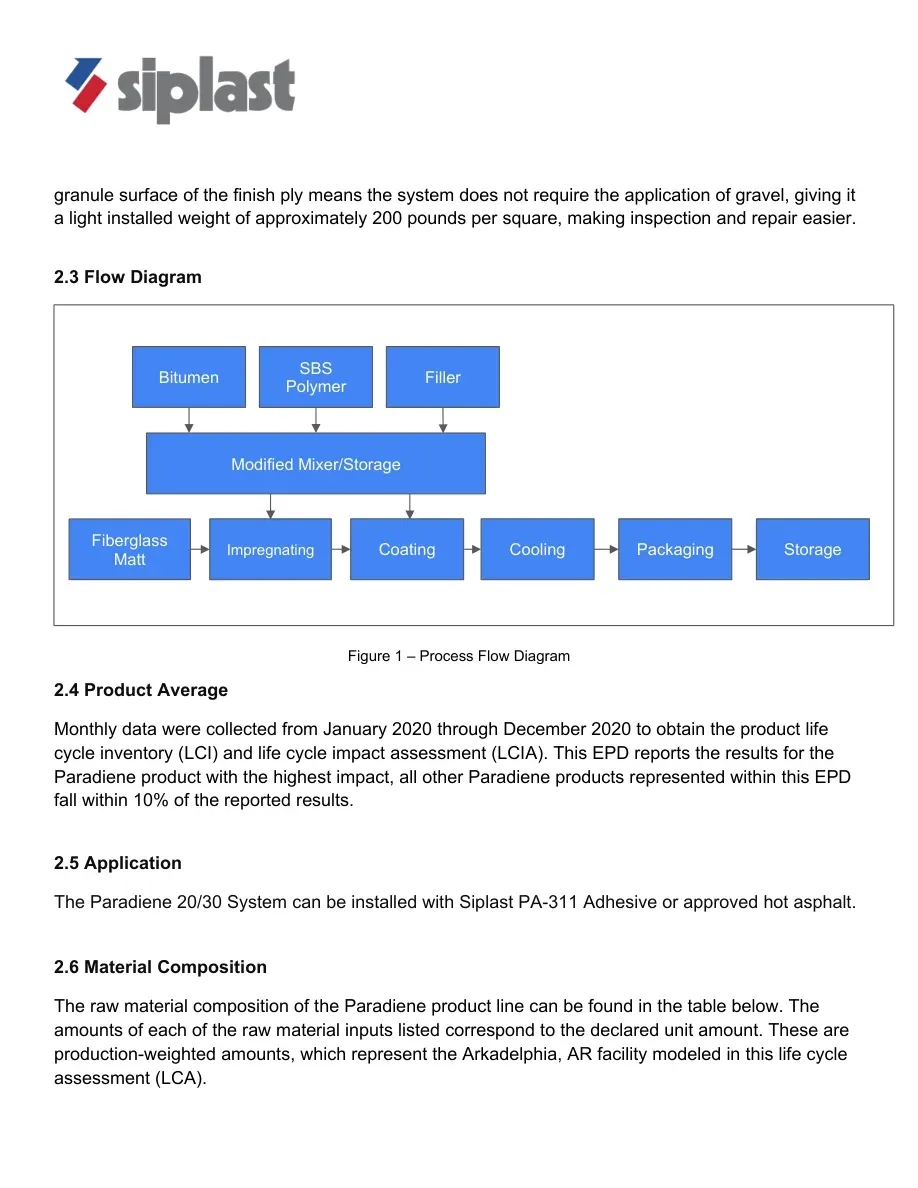
granule surface of the finish ply means the system does not require the application of gravel, giving it a light installed weight of approximately 200 pounds per square, making inspection and repair easier. 2.3 Flow Diagram Figure 1 – Process Flow Diagram 2.4 Product Average Monthly data were collected from January 2020 through December 2020 to obtain the product life cycle inventory (LCI) and life cycle impact assessment (LCIA). This EPD reports the results for the Paradiene product with the highest impact, all other Paradiene products represented within this EPD fall within 10% of the reported results. 2.5 Application The Paradiene 20/30 System can be installed with Siplast PA-311 Adhesive or approved hot asphalt. 2.6 Material Composition The raw material composition of the Paradiene product line can be found in the table below. The amounts of each of the raw material inputs listed correspond to the declared unit amount. These are production-weighted amounts, which represent the Arkadelphia, AR facility modeled in this life cycle assessment (LCA). Bitumen SBS Polymer Filler Modified Mixer/Storage Fiberglass Matt Impregnating Coating Cooling Packaging Storage
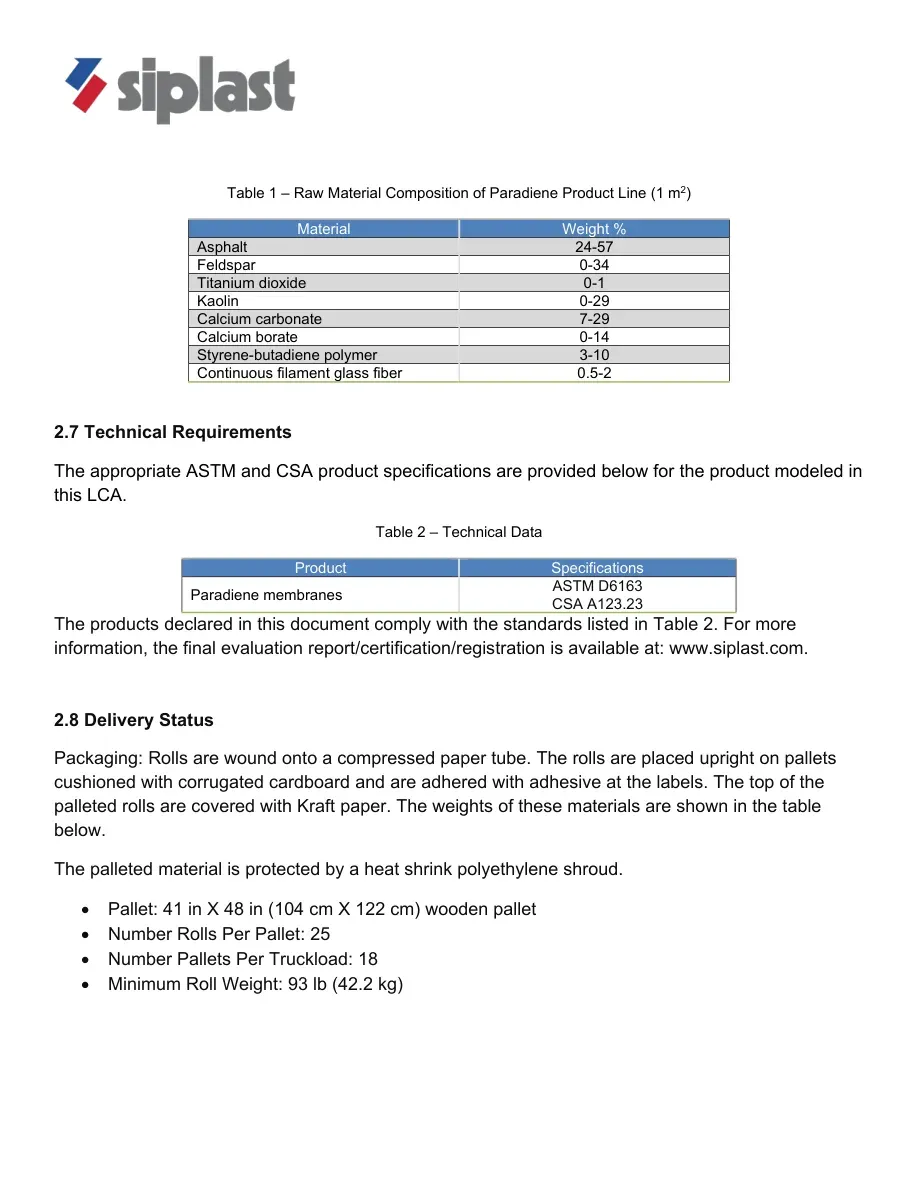
Table 1 – Raw Material Composition of Paradiene Product Line (1 m2) Material Weight % Asphalt 24-57 Feldspar 0-34 Titanium dioxide 0-1 Kaolin 0-29 Calcium carbonate 7-29 Calcium borate 0-14 Styrene-butadiene polymer 3-10 Continuous filament glass fiber 0.5-2 2.7 Technical Requirements The appropriate ASTM and CSA product specifications are provided below for the product modeled in this LCA. Table 2 – Technical Data Product Specifications Paradiene membranes ASTM D6163 CSA A123.23 The products declared in this document comply with the standards listed in Table 2. For more information, the final evaluation report/certification/registration is available at: www.siplast.com. 2.8 Delivery Status Packaging: Rolls are wound onto a compressed paper tube. The rolls are placed upright on pallets cushioned with corrugated cardboard and are adhered with adhesive at the labels. The top of the palleted rolls are covered with Kraft paper. The weights of these materials are shown in the table below. The palleted material is protected by a heat shrink polyethylene shroud. • Pallet: 41 in X 48 in (104 cm X 122 cm) wooden pallet • Number Rolls Per Pallet: 25 • Number Pallets Per Truckload: 18 • Minimum Roll Weight: 93 lb (42.2 kg)
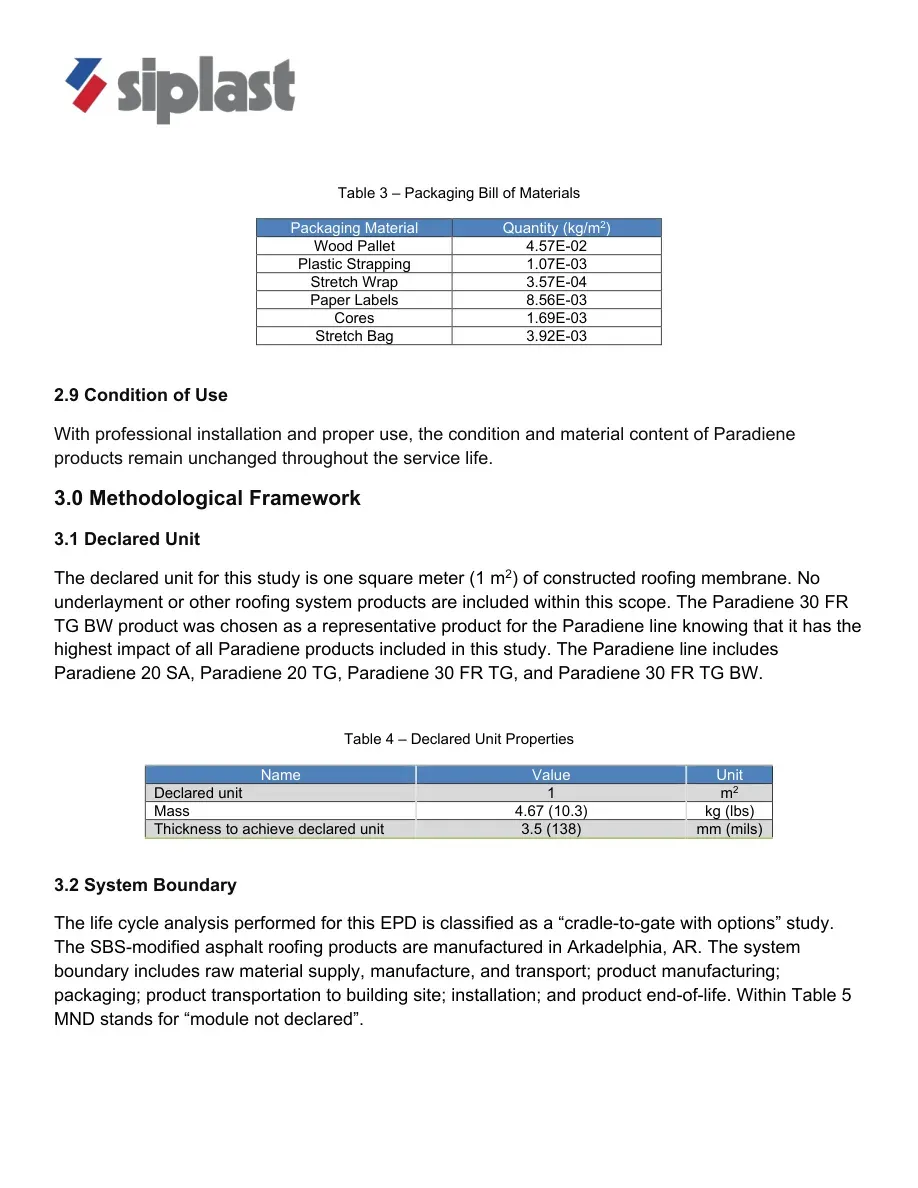
Table 3 – Packaging Bill of Materials Packaging Material Quantity (kg/m2) Wood Pallet 4.57E-02 Plastic Strapping 1.07E-03 Stretch Wrap 3.57E-04 Paper Labels 8.56E-03 Cores 1.69E-03 Stretch Bag 3.92E-03 2.9 Condition of Use With professional installation and proper use, the condition and material content of Paradiene products remain unchanged throughout the service life. 3.0 Methodological Framework 3.1 Declared Unit The declared unit for this study is one square meter (1 m2) of constructed roofing membrane. No underlayment or other roofing system products are included within this scope. The Paradiene 30 FR TG BW product was chosen as a representative product for the Paradiene line knowing that it has the highest impact of all Paradiene products included in this study. The Paradiene line includes Paradiene 20 SA, Paradiene 20 TG, Paradiene 30 FR TG, and Paradiene 30 FR TG BW. Table 4 – Declared Unit Properties Name Value Unit Declared unit 1 m2 Mass 4.67 (10.3) kg (lbs) Thickness to achieve declared unit 3.5 (138) mm (mils) 3.2 System Boundary The life cycle analysis performed for this EPD is classified as a “cradle-to-gate with options” study. The SBS-modified asphalt roofing products are manufactured in Arkadelphia, AR. The system boundary includes raw material supply, manufacture, and transport; product manufacturing; packaging; product transportation to building site; installation; and product end-of-life. Within Table 5 MND stands for “module not declared”.
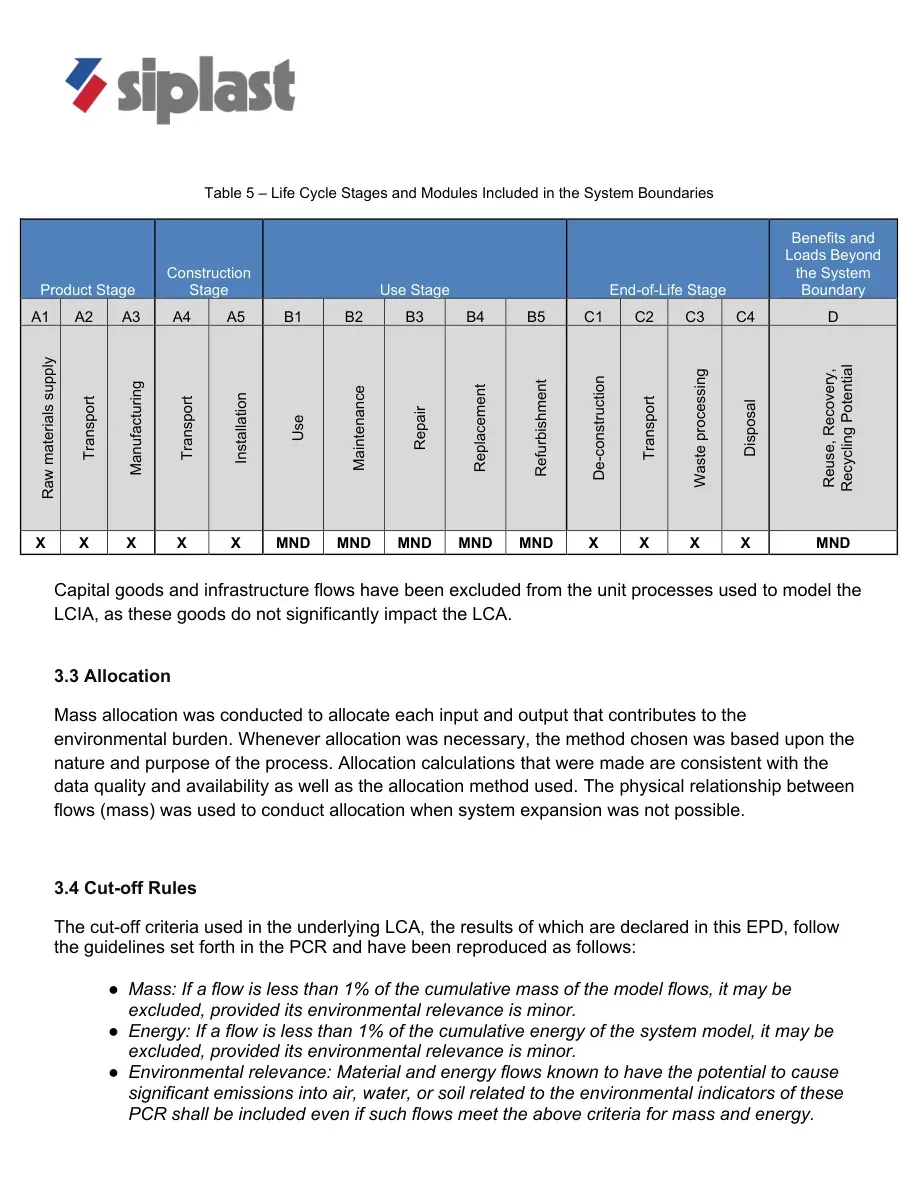
Table 5 – Life Cycle Stages and Modules Included in the System Boundaries Product Stage Construction Stage Use Stage End-of-Life Stage Benefits and Loads Beyond the System Boundary A1 A2 A3 A4 A5 B1 B2 B3 B4 B5 C1 C2 C3 C4 D Raw materials supply Transport Manufacturing Transport Installation Use Maintenance Repair Replacement Refurbishment De-construction Transport Waste processing Disposal Reuse, Recovery, Recycling Potential X X X X X MND MND MND MND MND X X X X MND Capital goods and infrastructure flows have been excluded from the unit processes used to model the LCIA, as these goods do not significantly impact the LCA. 3.3 Allocation Mass allocation was conducted to allocate each input and output that contributes to the environmental burden. Whenever allocation was necessary, the method chosen was based upon the nature and purpose of the process. Allocation calculations that were made are consistent with the data quality and availability as well as the allocation method used. The physical relationship between flows (mass) was used to conduct allocation when system expansion was not possible. 3.4 Cut-off Rules The cut-off criteria used in the underlying LCA, the results of which are declared in this EPD, follow the guidelines set forth in the PCR and have been reproduced as follows: ● Mass: If a flow is less than 1% of the cumulative mass of the model flows, it may be excluded, provided its environmental relevance is minor. ● Energy: If a flow is less than 1% of the cumulative energy of the system model, it may be excluded, provided its environmental relevance is minor. ● Environmental relevance: Material and energy flows known to have the potential to cause significant emissions into air, water, or soil related to the environmental indicators of these PCR shall be included even if such flows meet the above criteria for mass and energy.
● At least 95% of the energy usage and mass flow shall be included and the life-cycle impact data shall contain at least 95% of all elementary flows that contribute to each of the declared category indicators. ● A list of hazardous and toxic materials and substances shall be included in the inventory and the cutoff rules do not apply to such substances. No substances required to be reported as hazardous are associated with the production of this product. Following the cut-off criteria listed above, the energy required to install the fasteners onto the roofing shingle has been excluded as the overall electrical consumption of a nail gun is much less than the energy required to produce the materials. All reported data were incorporated and modeled using the best available LCI data. 3.5 Data Sources SimaPro version 9.1.1.1 software was utilized for modeling the complete cradle-to-gate with options LCI for the SBS-modified bitumen roofing membranes. The ecoinvent and USLCI databases serve as the sources of all secondary inventory for data. Third party verified ISO 14040/44 secondary LCI data sets contribute more than 67% of total impact to the required impact categories. 3.6 Data Quality As the relevant foreground data is primary data or modeled based on primary information sources of the owner of the technology, no better precision is reachable within this product. Seasonal variations were balanced by using yearly averages. All primary data were collected with the same level of detail, while all background data were sourced from SimaPro databases. Allocation and other methodological choices were made consistently throughout the model. The study’s geographical and technological coverage has been limited to North America, focusing on the region around Arkadelphia, AR where applicable, and the datasets used are less than 10 years old. 3.7 Period Under Review The period under review spans from January 2020 to December 2020.
3.8 Comparability and Benchmarking EPDs from different programs may not be comparable. Full conformance with a PCR allows EPD comparability only when all stages of a life cycle have been considered. However, variations and deviations are possible. Example of variations: Different LCA software and background LCI datasets may lead to different results upstream or downstream of the life cycle stages declared. 3.9 Estimates and Assumptions Life cycle analysis requires that assumptions are made to constrain the project boundary or model processes when little to no data are available. In this study of SBS-modified bitumen roofing membranes assumptions were made regarding the modeling of colemanite and granule raw materials. These raw materials were not available within the LCI databases and were thus built out using proxy materials. The following assumptions were made as per the PCR. An assumed distance of 800 kilometers was used for final product transportation. An assumed distance of 161 kilometers was used for transporting the product to waste processing at end of life. Paradiene products are assumed to be installed using propane torches which have an energy assumption of 2.39 MJ. 3.10 Units SI units are used to present the results of this study. 4.0 Technical Information and Scenarios LCIA results are presented per the declared unit (1 m2 of SBS-modified bitumen roofing membrane). 4.1 Manufacturing The process begins with the roll of fiberglass or polyester mat being mounted and fed into the mat accumulator machine. This machine accumulates the mat in accordion-style so that the machine can continue to run when the mat roll is exhausted and a new one is being mounted. The mat is then fed through the coater machine where the mats are pre-coated with the batch of asphalt and polymers. The mix of asphalt must be heated in order to be applied as a thick liquid. Any films associated with the product being manufactured are applied at this point. The next coat is the filler of granules or sand and any other specified chemicals for the product being made. Cooling the mat is completed through
evaporative cooling. Once the mat is cooled and dried, it is wound onto the cardboard core and the finished roll is packaged. 4.2 Packaging Packaging of the final product after production is included in the LCA. Per the PCR, the release film used on the SBS-modified bitumen roofing product is to be included as packaging material. Rolls are wound onto a compressed tube. The rolls are placed upright on end opposite the selvage on pallets cushioned with corrugated cardboard and are adhered with adhesive at the labels. The top of the palleted rolls is covered with Kraft paper. The palleted material is protected by a heat shrink polyethylene shroud. 4.3 Transportation The following table details the transportation of the product to the building site. Table 6 – Transport to the Building Site (A4) Name Value Unit Fuel type Diesel - Liters of fuel 38 l/100 km Vehicle type Combination Truck - Transport distance 800 km Capacity utilization (including empty runs, mass based) 100 % Gross density of products transported - kg/m3 Capacity utilization volume factor 1 -
4.4 Product Installation The following table details the transportation of the product to the building site. Table 7 – Installation (A5) Name Value Unit Ancillary materials - kg Net freshwater consumption specified by water source and fate - m3 Other resources - kg Electricity consumption - kWh Other energy carriers 2.39 MJ Product loss per declared unit 0.268 kg Waste materials at the construction site before waste processing, generated by product installation 0.268 kg Output materials resulting from on-site waste processing (going to landfill) 0.268 kg Mass of packaging waste, landfill 0.069 kg Biogenic carbon contained in packaging 0.032 kg CO2 Direct emissions to ambient air, soil, and water *See profile of propane production in table below VOC content Table 8 – Installation (A5) Air Emissions Profile Air Emission Value (kg) Acetaldehyde 2.51E-09 Acetic acid 3.77E-07 Benzene 1.00E-06 Benzo(a)pyrene 2.51E-11 Butane 1.76E-06 Carbon dioxide, fossil 1.60E-01 Carbon monoxide, fossil 1.15E-03 Dinitrogen monoxide 2.51E-07 Formaldehyde 2.51E-07 Mercury 7.53E-11 Methane, fossil 5.02E-06 Nitrogen oxides 2.49E-04 PAH, polycyclic aromatic hydrocarbons 2.51E-08 Particulates, < 2.5 um 1.47E-05 Pentane 3.01E-06 Propane 5.02E-07 Propionic acid 5.02E-08 Sulfur dioxide 5.40E-06 Toluene 5.02E-07
4.5 Disposal Deconstruction (module C1) of SBS-modified bitumen roofing product is typically completed with manual labor using roofing shovels and crow bars. At this time, there are no recycling scenarios and processing scenarios (module C3) for SBS-modified bitumen roofing products at the end of the service life. This study assumes the deconstruction and waste processing modules to be burden free. Disposal in a municipal landfill or in commercial incineration facilities is permissible and should be done in accordance with local, provincial, and federal regulations. Table 9 – End-of-Life Name Value Unit Assumptions for scenario development (description of deconstruction, collection, recovery, disposal method, and transportation) Products are manually removed from the roof and typically combined with construction and demolition waste. Collection process (specified by type) Collected separately - kg Collected with mixed construction waste 5.36E+00 kg Recovery (specified by type) Reuse - kg Recycling kg Landfill 5.36E+00 kg Incineration - kg Incineration with energy recovery - kg Energy conversion efficiency rate - - Disposal (specified by type) Product or material for final deposition Membrane Waste: 5.36E+00 kg Removals of biogenic carbon (excluding packaging) - kg CO2 5.0 Paradiene Environmental Indicators Results 5.1 Life Cycle Impact Assessment Results Results are reported based on characterization factors from the US EPA Tool for the Reduction and Assessment of Chemical and Other Environmental Impacts (TRACI 2.1 impact categories). These impact categories include global warming potential, ozone depletion potential, acidification potential, eutrophication potential, smog creation potential, and abiotic depletion potential (fossil). These six impact categories are globally deemed mature enough to be included in Type III environmental declarations. Other categories are being developed and defined and LCA should continue making advances in their development, however the EPD users shall not use additional measures for comparative purposes. Additionally, impact categories taken from the University of Leiden (CML) methodology are reported to facilitate the use of this EPD outside of North America. LCA results are presented per the declared unit (1 m2 of SBS-modified bitumen roofing membrane). Note that, at this point, the reported impact categories represent impact potentials, i.e., they are approximations of environmental impacts that could occur if the emissions would (a) follow the underlying impact pathway and (b) meet certain conditions in the receiving environment while doing so. LCIA results are therefore relative expressions only and do not predict actual impacts, the exceeding of thresholds, safety margins, or risks.
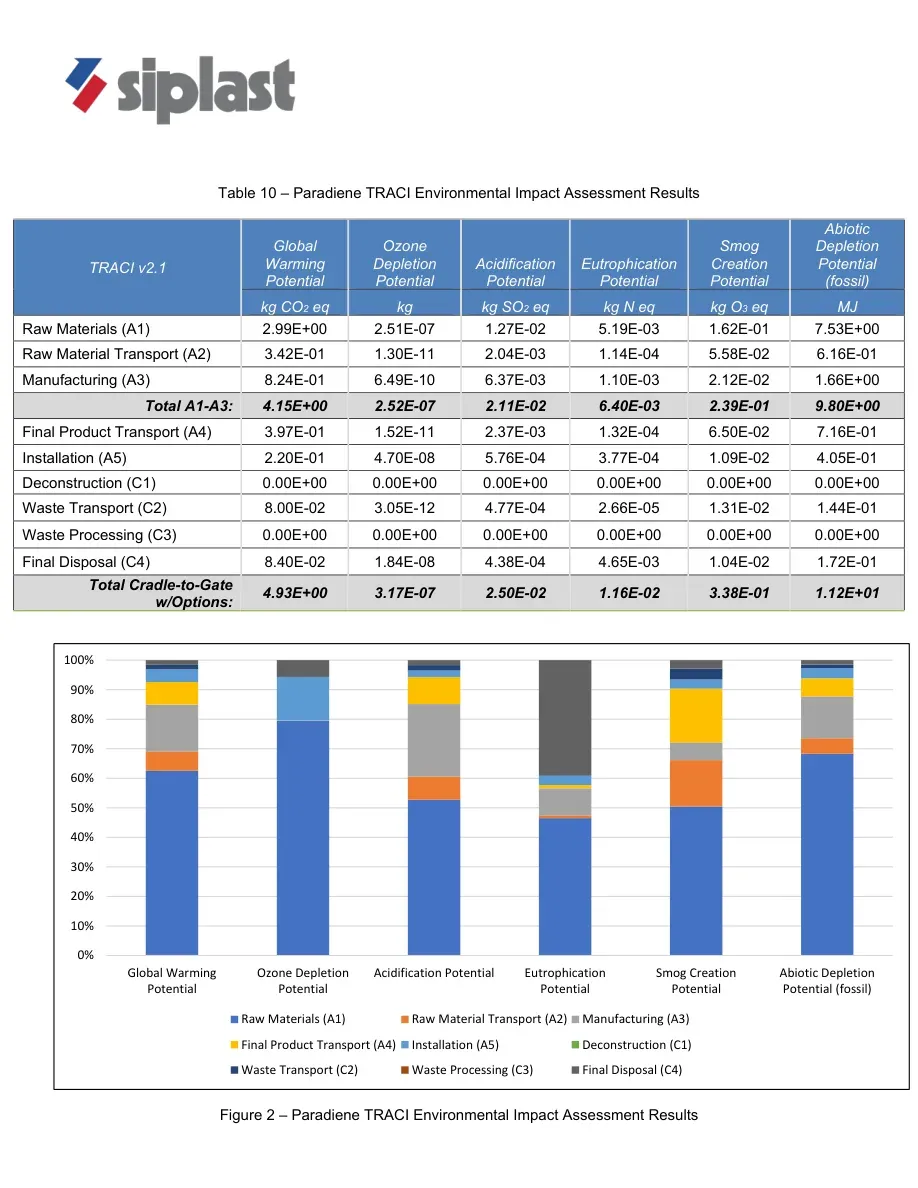
Table 10 – Paradiene TRACI Environmental Impact Assessment Results TRACI v2.1 Global Warming Potential Ozone Depletion Potential Acidification Potential Eutrophication Potential Smog Creation Potential Abiotic Depletion Potential (fossil) kg CO2 eq kg kg SO2 eq kg N eq kg O3 eq MJ Raw Materials (A1) 2.99E+00 2.51E-07 1.27E-02 5.19E-03 1.62E-01 7.53E+00 Raw Material Transport (A2) 3.42E-01 1.30E-11 2.04E-03 1.14E-04 5.58E-02 6.16E-01 Manufacturing (A3) 8.24E-01 6.49E-10 6.37E-03 1.10E-03 2.12E-02 1.66E+00 Total A1-A3: 4.15E+00 2.52E-07 2.11E-02 6.40E-03 2.39E-01 9.80E+00 Final Product Transport (A4) 3.97E-01 1.52E-11 2.37E-03 1.32E-04 6.50E-02 7.16E-01 Installation (A5) 2.20E-01 4.70E-08 5.76E-04 3.77E-04 1.09E-02 4.05E-01 Deconstruction (C1) 0.00E+00 0.00E+00 0.00E+00 0.00E+00 0.00E+00 0.00E+00 Waste Transport (C2) 8.00E-02 3.05E-12 4.77E-04 2.66E-05 1.31E-02 1.44E-01 Waste Processing (C3) 0.00E+00 0.00E+00 0.00E+00 0.00E+00 0.00E+00 0.00E+00 Final Disposal (C4) 8.40E-02 1.84E-08 4.38E-04 4.65E-03 1.04E-02 1.72E-01 Total Cradle-to-Gate w/Options: 4.93E+00 3.17E-07 2.50E-02 1.16E-02 3.38E-01 1.12E+01 Figure 2 – Paradiene TRACI Environmental Impact Assessment Results 0%10%20%30%40%50%60%70%80%90%100%Global WarmingPotentialOzone DepletionPotentialAcidification PotentialEutrophicationPotentialSmog CreationPotentialAbiotic DepletionPotential (fossil)Raw Materials (A1)Raw Material Transport (A2)Manufacturing (A3)Final Product Transport (A4)Installation (A5)Deconstruction (C1)Waste Transport (C2)Waste Processing (C3)Final Disposal (C4)
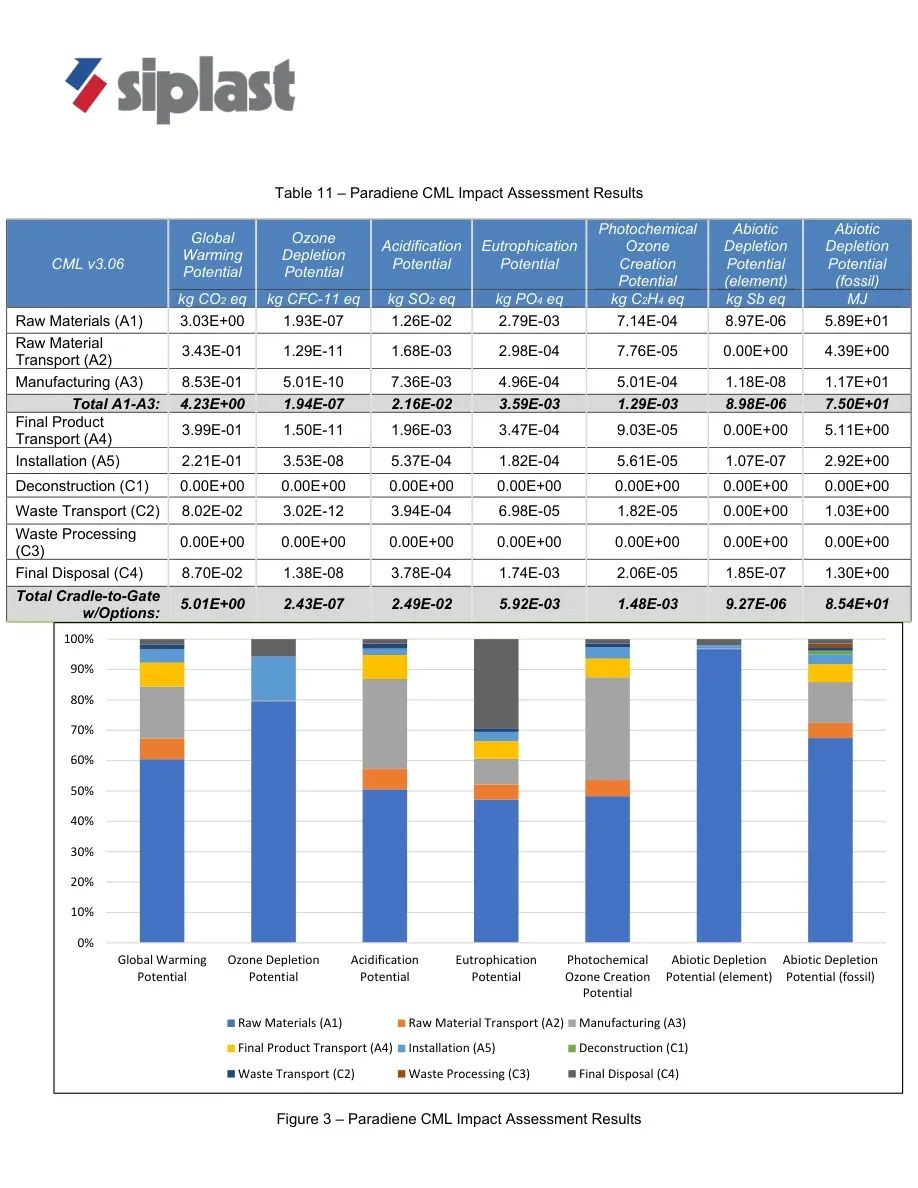
Table 11 – Paradiene CML Impact Assessment Results CML v3.06 Global Warming Potential Ozone Depletion Potential Acidification Potential Eutrophication Potential Photochemical Ozone Creation Potential Abiotic Depletion Potential (element) Abiotic Depletion Potential (fossil) kg CO2 eq kg CFC-11 eq kg SO2 eq kg PO4 eq kg C2H4 eq kg Sb eq MJ Raw Materials (A1) 3.03E+00 1.93E-07 1.26E-02 2.79E-03 7.14E-04 8.97E-06 5.89E+01 Raw Material Transport (A2) 3.43E-01 1.29E-11 1.68E-03 2.98E-04 7.76E-05 0.00E+00 4.39E+00 Manufacturing (A3) 8.53E-01 5.01E-10 7.36E-03 4.96E-04 5.01E-04 1.18E-08 1.17E+01 Total A1-A3: 4.23E+00 1.94E-07 2.16E-02 3.59E-03 1.29E-03 8.98E-06 7.50E+01 Final Product Transport (A4) 3.99E-01 1.50E-11 1.96E-03 3.47E-04 9.03E-05 0.00E+00 5.11E+00 Installation (A5) 2.21E-01 3.53E-08 5.37E-04 1.82E-04 5.61E-05 1.07E-07 2.92E+00 Deconstruction (C1) 0.00E+00 0.00E+00 0.00E+00 0.00E+00 0.00E+00 0.00E+00 0.00E+00 Waste Transport (C2) 8.02E-02 3.02E-12 3.94E-04 6.98E-05 1.82E-05 0.00E+00 1.03E+00 Waste Processing (C3) 0.00E+00 0.00E+00 0.00E+00 0.00E+00 0.00E+00 0.00E+00 0.00E+00 Final Disposal (C4) 8.70E-02 1.38E-08 3.78E-04 1.74E-03 2.06E-05 1.85E-07 1.30E+00 Total Cradle-to-Gate w/Options: 5.01E+00 2.43E-07 2.49E-02 5.92E-03 1.48E-03 9.27E-06 8.54E+01 Figure 3 – Paradiene CML Impact Assessment Results 0%10%20%30%40%50%60%70%80%90%100%Global WarmingPotentialOzone DepletionPotentialAcidificationPotentialEutrophicationPotentialPhotochemicalOzone CreationPotentialAbiotic DepletionPotential (element)Abiotic DepletionPotential (fossil)Raw Materials (A1)Raw Material Transport (A2)Manufacturing (A3)Final Product Transport (A4)Installation (A5)Deconstruction (C1)Waste Transport (C2)Waste Processing (C3)Final Disposal (C4)
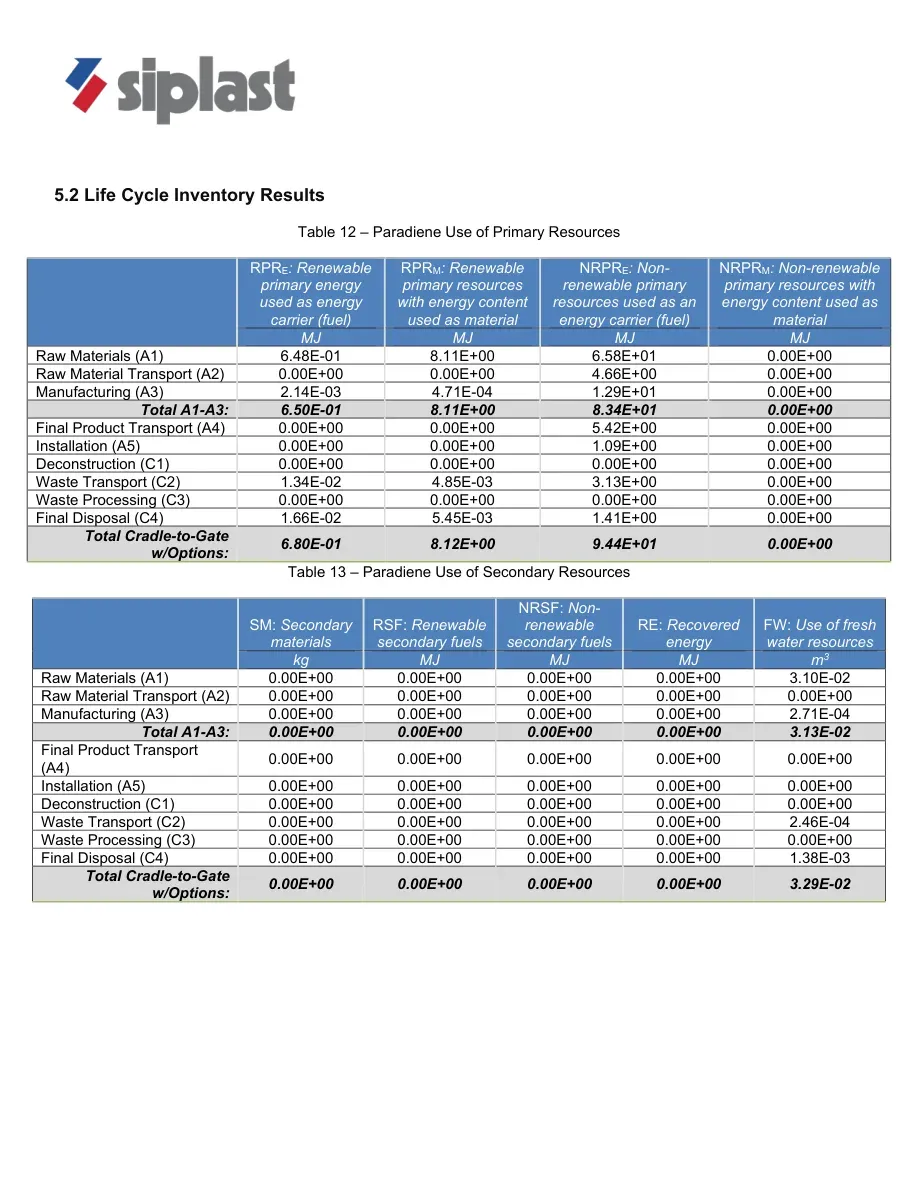
5.2 Life Cycle Inventory Results Table 12 – Paradiene Use of Primary Resources RPRE: Renewable primary energy used as energy carrier (fuel) RPRM: Renewable primary resources with energy content used as material NRPRE: Non-renewable primary resources used as an energy carrier (fuel) NRPRM: Non-renewable primary resources with energy content used as material MJ MJ MJ MJ Raw Materials (A1) 6.48E-01 8.11E+00 6.58E+01 0.00E+00 Raw Material Transport (A2) 0.00E+00 0.00E+00 4.66E+00 0.00E+00 Manufacturing (A3) 2.14E-03 4.71E-04 1.29E+01 0.00E+00 Total A1-A3: 6.50E-01 8.11E+00 8.34E+01 0.00E+00 Final Product Transport (A4) 0.00E+00 0.00E+00 5.42E+00 0.00E+00 Installation (A5) 0.00E+00 0.00E+00 1.09E+00 0.00E+00 Deconstruction (C1) 0.00E+00 0.00E+00 0.00E+00 0.00E+00 Waste Transport (C2) 1.34E-02 4.85E-03 3.13E+00 0.00E+00 Waste Processing (C3) 0.00E+00 0.00E+00 0.00E+00 0.00E+00 Final Disposal (C4) 1.66E-02 5.45E-03 1.41E+00 0.00E+00 Total Cradle-to-Gate w/Options: 6.80E-01 8.12E+00 9.44E+01 0.00E+00 Table 13 – Paradiene Use of Secondary Resources SM: Secondary materials RSF: Renewable secondary fuels NRSF: Non-renewable secondary fuels RE: Recovered energy FW: Use of fresh water resources kg MJ MJ MJ m3 Raw Materials (A1) 0.00E+00 0.00E+00 0.00E+00 0.00E+00 3.10E-02 Raw Material Transport (A2) 0.00E+00 0.00E+00 0.00E+00 0.00E+00 0.00E+00 Manufacturing (A3) 0.00E+00 0.00E+00 0.00E+00 0.00E+00 2.71E-04 Total A1-A3: 0.00E+00 0.00E+00 0.00E+00 0.00E+00 3.13E-02 Final Product Transport (A4) 0.00E+00 0.00E+00 0.00E+00 0.00E+00 0.00E+00 Installation (A5) 0.00E+00 0.00E+00 0.00E+00 0.00E+00 0.00E+00 Deconstruction (C1) 0.00E+00 0.00E+00 0.00E+00 0.00E+00 0.00E+00 Waste Transport (C2) 0.00E+00 0.00E+00 0.00E+00 0.00E+00 2.46E-04 Waste Processing (C3) 0.00E+00 0.00E+00 0.00E+00 0.00E+00 0.00E+00 Final Disposal (C4) 0.00E+00 0.00E+00 0.00E+00 0.00E+00 1.38E-03 Total Cradle-to-Gate w/Options: 0.00E+00 0.00E+00 0.00E+00 0.00E+00 3.29E-02
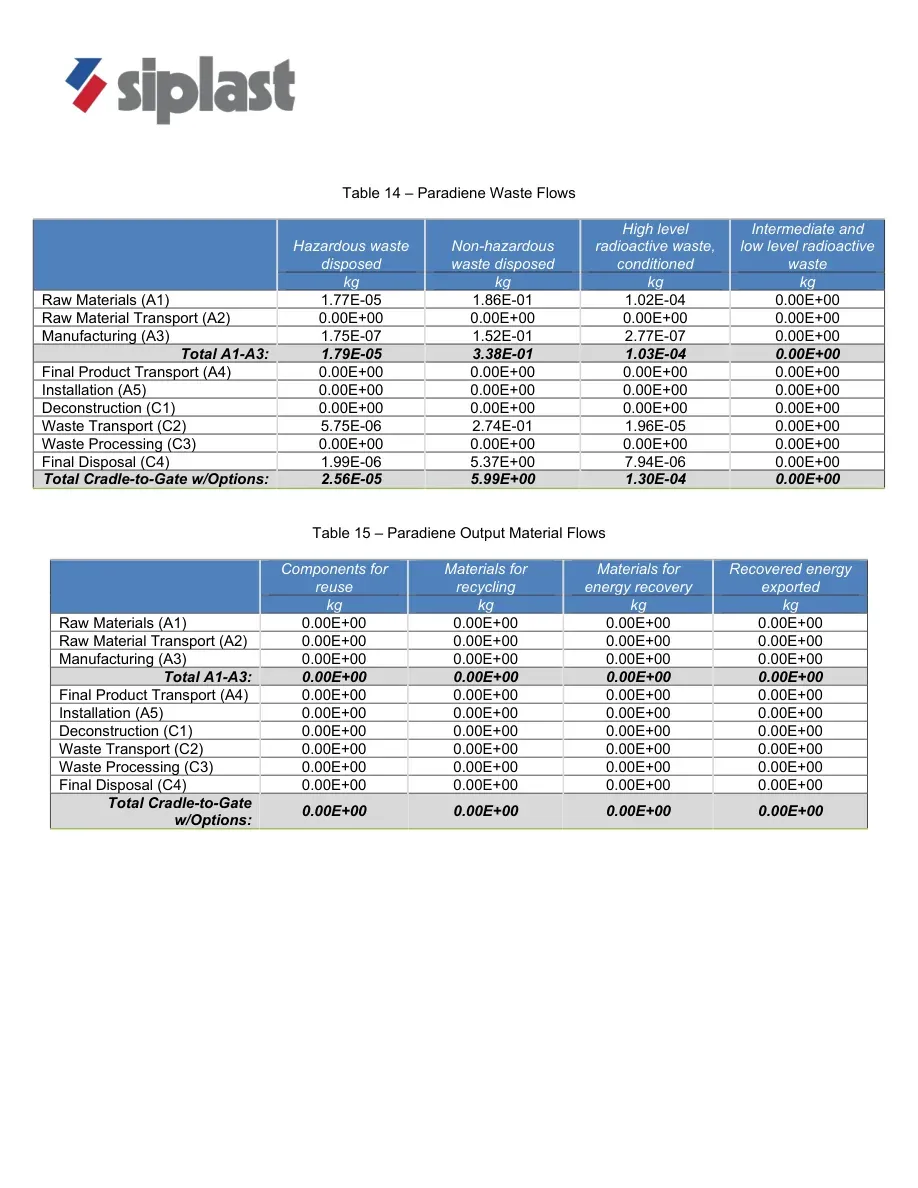
Table 14 – Paradiene Waste Flows Hazardous waste disposed Non-hazardous waste disposed High level radioactive waste, conditioned Intermediate and low level radioactive waste kg kg kg kg Raw Materials (A1) 1.77E-05 1.86E-01 1.02E-04 0.00E+00 Raw Material Transport (A2) 0.00E+00 0.00E+00 0.00E+00 0.00E+00 Manufacturing (A3) 1.75E-07 1.52E-01 2.77E-07 0.00E+00 Total A1-A3: 1.79E-05 3.38E-01 1.03E-04 0.00E+00 Final Product Transport (A4) 0.00E+00 0.00E+00 0.00E+00 0.00E+00 Installation (A5) 0.00E+00 0.00E+00 0.00E+00 0.00E+00 Deconstruction (C1) 0.00E+00 0.00E+00 0.00E+00 0.00E+00 Waste Transport (C2) 5.75E-06 2.74E-01 1.96E-05 0.00E+00 Waste Processing (C3) 0.00E+00 0.00E+00 0.00E+00 0.00E+00 Final Disposal (C4) 1.99E-06 5.37E+00 7.94E-06 0.00E+00 Total Cradle-to-Gate w/Options: 2.56E-05 5.99E+00 1.30E-04 0.00E+00 Table 15 – Paradiene Output Material Flows Components for reuse Materials for recycling Materials for energy recovery Recovered energy exported kg kg kg kg Raw Materials (A1) 0.00E+00 0.00E+00 0.00E+00 0.00E+00 Raw Material Transport (A2) 0.00E+00 0.00E+00 0.00E+00 0.00E+00 Manufacturing (A3) 0.00E+00 0.00E+00 0.00E+00 0.00E+00 Total A1-A3: 0.00E+00 0.00E+00 0.00E+00 0.00E+00 Final Product Transport (A4) 0.00E+00 0.00E+00 0.00E+00 0.00E+00 Installation (A5) 0.00E+00 0.00E+00 0.00E+00 0.00E+00 Deconstruction (C1) 0.00E+00 0.00E+00 0.00E+00 0.00E+00 Waste Transport (C2) 0.00E+00 0.00E+00 0.00E+00 0.00E+00 Waste Processing (C3) 0.00E+00 0.00E+00 0.00E+00 0.00E+00 Final Disposal (C4) 0.00E+00 0.00E+00 0.00E+00 0.00E+00 Total Cradle-to-Gate w/Options: 0.00E+00 0.00E+00 0.00E+00 0.00E+00
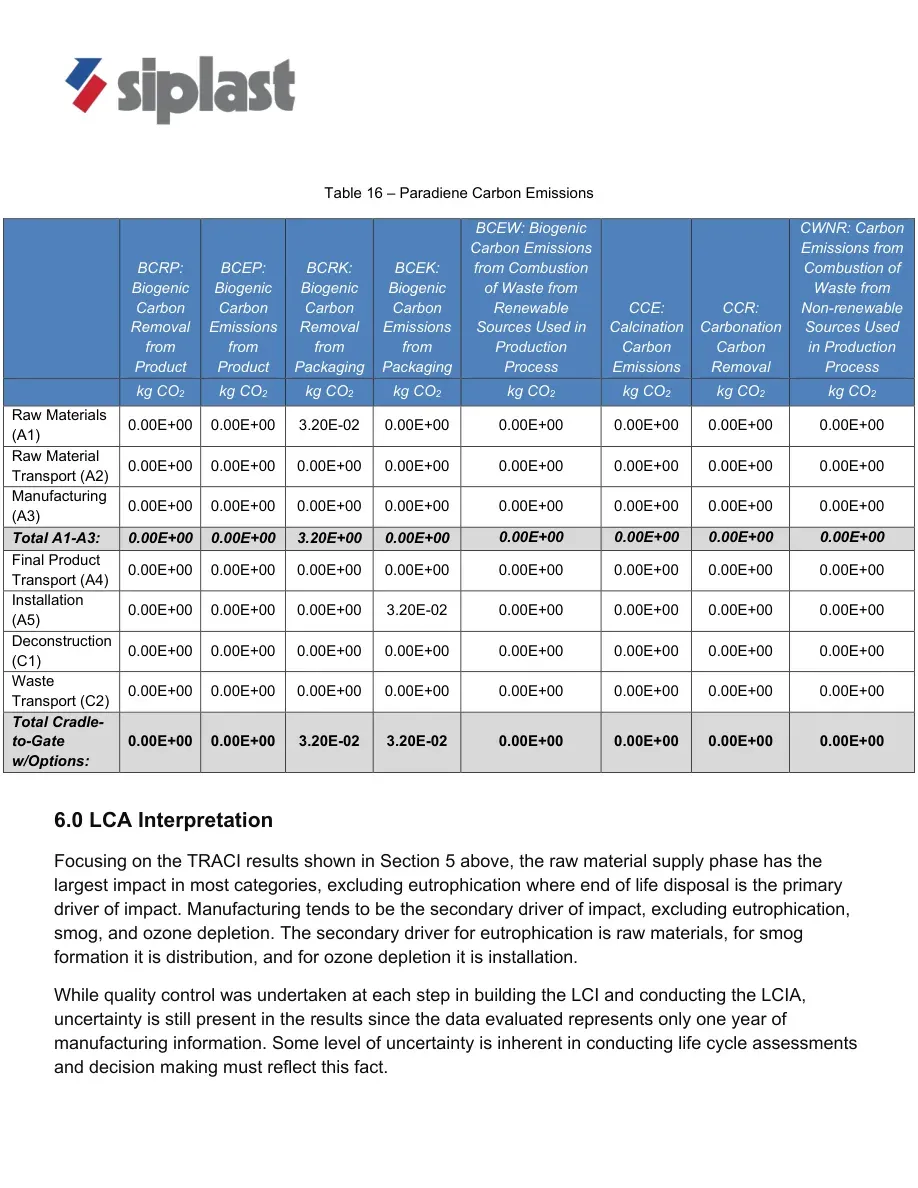
Table 16 – Paradiene Carbon Emissions BCRP: Biogenic Carbon Removal from Product BCEP: Biogenic Carbon Emissions from Product BCRK: Biogenic Carbon Removal from Packaging BCEK: Biogenic Carbon Emissions from Packaging BCEW: Biogenic Carbon Emissions from Combustion of Waste from Renewable Sources Used in Production Process CCE: Calcination Carbon Emissions CCR: Carbonation Carbon Removal CWNR: Carbon Emissions from Combustion of Waste from Non-renewable Sources Used in Production Process kg CO2 kg CO2 kg CO2 kg CO2 kg CO2 kg CO2 kg CO2 kg CO2 Raw Materials (A1) 0.00E+00 0.00E+00 3.20E-02 0.00E+00 0.00E+00 0.00E+00 0.00E+00 0.00E+00 Raw Material Transport (A2) 0.00E+00 0.00E+00 0.00E+00 0.00E+00 0.00E+00 0.00E+00 0.00E+00 0.00E+00 Manufacturing (A3) 0.00E+00 0.00E+00 0.00E+00 0.00E+00 0.00E+00 0.00E+00 0.00E+00 0.00E+00 Total A1-A3: 0.00E+00 0.00E+00 3.20E+00 0.00E+00 0.00E+00 0.00E+00 0.00E+00 0.00E+00 Final Product Transport (A4) 0.00E+00 0.00E+00 0.00E+00 0.00E+00 0.00E+00 0.00E+00 0.00E+00 0.00E+00 Installation (A5) 0.00E+00 0.00E+00 0.00E+00 3.20E-02 0.00E+00 0.00E+00 0.00E+00 0.00E+00 Deconstruction (C1) 0.00E+00 0.00E+00 0.00E+00 0.00E+00 0.00E+00 0.00E+00 0.00E+00 0.00E+00 Waste Transport (C2) 0.00E+00 0.00E+00 0.00E+00 0.00E+00 0.00E+00 0.00E+00 0.00E+00 0.00E+00 Total Cradle-to-Gate w/Options: 0.00E+00 0.00E+00 3.20E-02 3.20E-02 0.00E+00 0.00E+00 0.00E+00 0.00E+00 6.0 LCA Interpretation Focusing on the TRACI results shown in Section 5 above, the raw material supply phase has the largest impact in most categories, excluding eutrophication where end of life disposal is the primary driver of impact. Manufacturing tends to be the secondary driver of impact, excluding eutrophication, smog, and ozone depletion. The secondary driver for eutrophication is raw materials, for smog formation it is distribution, and for ozone depletion it is installation. While quality control was undertaken at each step in building the LCI and conducting the LCIA, uncertainty is still present in the results since the data evaluated represents only one year of manufacturing information. Some level of uncertainty is inherent in conducting life cycle assessments and decision making must reflect this fact.
7.0 Additional Environmental Information 7.1 Environment and Health During Manufacture Siplast is committed to producing and distributing roofing membranes with minimal environmental impact. Health and safety are the primary focus for all employees. 7.2 Environment and Health During Installation No damage to health or impairment is expected under normal installation corresponding to the intended use of the product. For more detailed safety information, refer to the product's Safety Data Sheet (SDS), which is available on Siplast's website. 7.3 Extraordinary Effects Fire Resistance by the roofing system to fire applied to the exterior roof surface is important. Typically, a UL Class A or B rating is required by building code. Occasionally, depending on the use of the building, special resistance to fire applied from within the building is required. This is normally expressed in the form of hourly ratings, and usually requires the use of a specialized roof assembly. Refer to current Paradiene listings in the appropriate UL directory to verify roof assembly requirements for specific fire ratings. 7.4 Extraordinary Effects Water No environmental impacts are expected due to water exposure of properly installed Paradiene products. 7.5 Extraordinary Effects Mechanical Destruction Paradiene products have excellent mechanical strength. The tear strength and elongation at break performance are measured by ASTM D5147 and test results confirm Paradiene products have a tear strength of 40 lbf and ultimate elongation of 55% to 80% depending on the product.
8.0 References Product Category Rule for Building-Related Product and Services Part A: Life Cycle Assessment Calculation Rules and Report Requirements UL Environment (December 2018, version 3.2) Product Category Rule for Building-Related Product and Services Part B: Asphalt Shingles, Built-up Asphalt Membrane Roofing and Modified Bituminous Membrane Roofing EPD Requirements UL Environment (July 2019, version 2.0) EN 15804 + A1:2013, Sustainability of construction works — Environmental product declarations — Core rules for the product category of construction products. ISO 14025:2011-10, Environmental labels and declarations — Type III environmental declarations — Principles and procedures. ISO 14040:2009-11, Environmental management — Life cycle assessment — Principles and framework. ISO 14044:2006/Amd 1:2017, Environmental Management — Life cycle assessment — Requirements and Instructions. ISO 21930:2017, Sustainability in buildings and civil engineering works — Core rules for environmental product declarations of construction products and services.
9.0 Contact Information 9.1 Study Commissioner 9.2 LCA Practitioner Siplast Roofing Products 1000 Rochelle Blvd. Irving, TX 75062-3940 Toll: (800) 922-8800 Tel: (469) 995-2200 Fax: (469) 995-2205 usinfo@siplast.com www.siplast.com Sustainable Solutions Corporation 155 Railroad Plaza, Suite 203 Royersford, PA 19468 USA (610) 569-1047 info@sustainablesolutionscorporation.com www.sustainablesolutionscorporation.com
