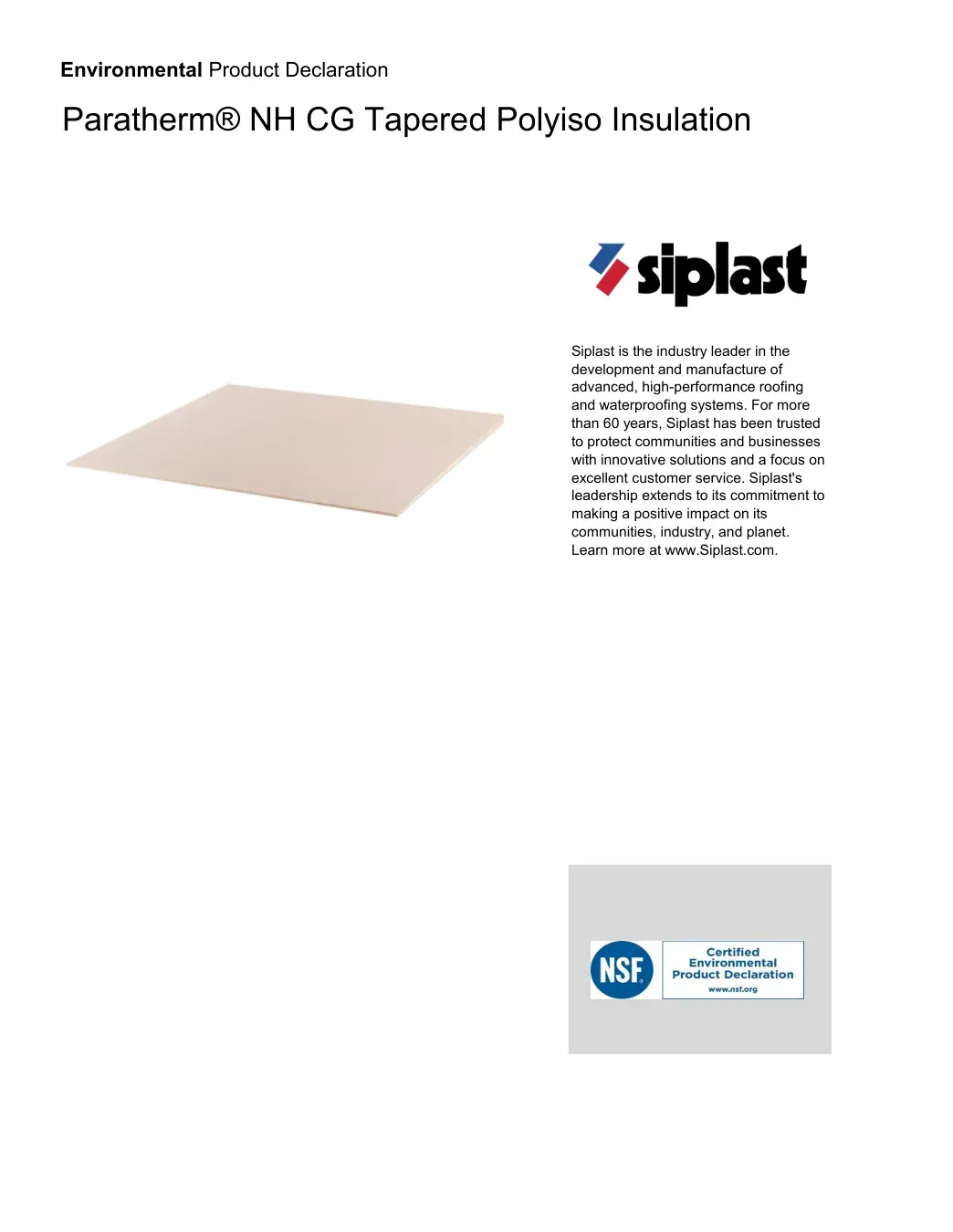
Environmental Product DeclarationParatherm® NH CG Tapered Polyiso InsulationSiplast is the industry leader in the development and manufacture of advanced, high-performance roofing and waterproofing systems. For more than 60 years, Siplast has been trusted to protect communities and businesses with innovative solutions and a focus on excellent customer service. Siplast's leadership extends to its commitment to making a positive impact on its communities, industry, and planet. Learn more at www.Siplast.com.
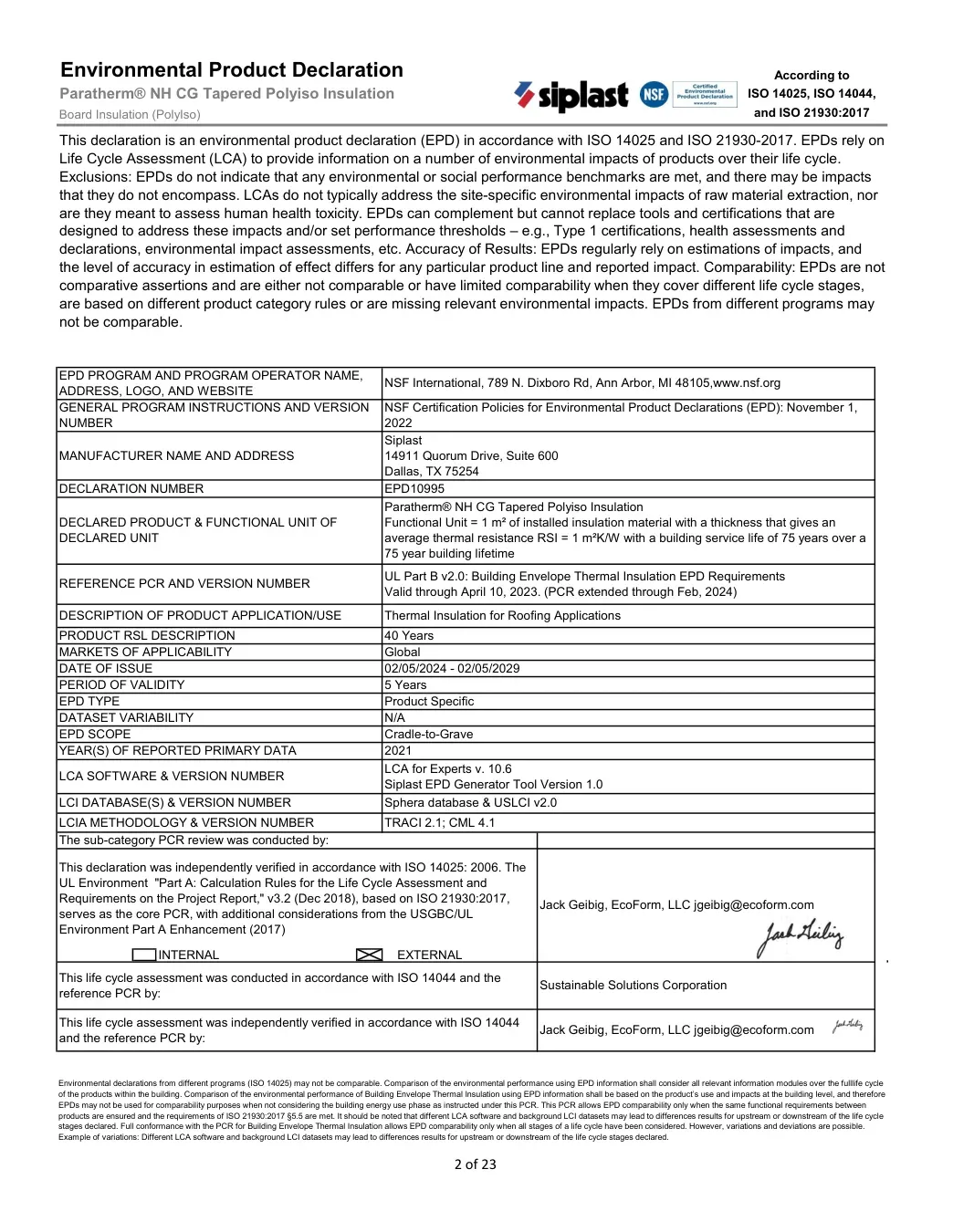
INTERNALEXTERNALEnvironmental declarations from different programs (ISO 14025) may not be comparable. Comparison of the environmental performance using EPD information shall consider all relevant information modules over the fulllife cycle of the products within the building. Comparison of the environmental performance of Building Envelope Thermal Insulation using EPD information shall be based on the product’s use and impacts at the building level, and therefore EPDs may not be used for comparability purposes when not considering the building energy use phase as instructed under this PCR. This PCR allows EPD comparability only when the same functional requirements between products are ensured and the requirements of ISO 21930:2017 §5.5 are met. It should be noted that different LCA software and background LCI datasets may lead to differences results for upstream or downstream of the life cycle stages declared. Full conformance with the PCR for Building Envelope Thermal Insulation allows EPD comparability only when all stages of a life cycle have been considered. However, variations and deviations are possible. Example of variations: Different LCA software and background LCI datasets may lead to differences results for upstream or downstream of the life cycle stages declared.YEAR(S) OF REPORTED PRIMARY DATA2021LCA SOFTWARE & VERSION NUMBERREFERENCE PCR AND VERSION NUMBERUL Part B v2.0: Building Envelope Thermal Insulation EPD RequirementsValid through April 10, 2023. (PCR extended through Feb, 2024) PERIOD OF VALIDITY5 YearsEPD TYPEProduct SpecificDATASET VARIABILITYN/ADATE OF ISSUE02/05/2024 - 02/05/2029GENERAL PROGRAM INSTRUCTIONS AND VERSION NUMBEREPD PROGRAM AND PROGRAM OPERATOR NAME, ADDRESS, LOGO, AND WEBSITENSF International, 789 N. Dixboro Rd, Ann Arbor, MI 48105,www.nsf.orgEnvironmental Product DeclarationBoard Insulation (PolyIso)Cradle-to-GraveDECLARATION NUMBERISO 14025, ISO 14044,NSF Certification Policies for Environmental Product Declarations (EPD): November 1, 2022MANUFACTURER NAME AND ADDRESSSiplast 14911 Quorum Drive, Suite 600Dallas, TX 75254LCI DATABASE(S) & VERSION NUMBERPRODUCT RSL DESCRIPTIONSphera database & USLCI v2.0Paratherm® NH CG Tapered Polyiso InsulationThis declaration is an environmental product declaration (EPD) in accordance with ISO 14025 and ISO 21930-2017. EPDs rely on Life Cycle Assessment (LCA) to provide information on a number of environmental impacts of products over their life cycle. Exclusions: EPDs do not indicate that any environmental or social performance benchmarks are met, and there may be impacts that they do not encompass. LCAs do not typically address the site-specific environmental impacts of raw material extraction, nor are they meant to assess human health toxicity. EPDs can complement but cannot replace tools and certifications that are designed to address these impacts and/or set performance thresholds – e.g., Type 1 certifications, health assessments and declarations, environmental impact assessments, etc. Accuracy of Results: EPDs regularly rely on estimations of impacts, and the level of accuracy in estimation of effect differs for any particular product line and reported impact. Comparability: EPDs are not comparative assertions and are either not comparable or have limited comparability when they cover different life cycle stages, are based on different product category rules or are missing relevant environmental impacts. EPDs from different programs may not be comparable.Thermal Insulation for Roofing ApplicationsLCA for Experts v. 10.6Siplast EPD Generator Tool Version 1.0LCIA METHODOLOGY & VERSION NUMBERAccording toEPD SCOPEand ISO 21930:2017The sub-category PCR review was conducted by:EPD10995DECLARED PRODUCT & FUNCTIONAL UNIT OF DECLARED UNITParatherm® NH CG Tapered Polyiso InsulationFunctional Unit = 1 m² of installed insulation material with a thickness that gives an average thermal resistance RSI = 1 m²K/W with a building service life of 75 years over a 75 year building lifetimeDESCRIPTION OF PRODUCT APPLICATION/USEThis declaration was independently verified in accordance with ISO 14025: 2006. The UL Environment "Part A: Calculation Rules for the Life Cycle Assessment and Requirements on the Project Report," v3.2 (Dec 2018), based on ISO 21930:2017, serves as the core PCR, with additional considerations from the USGBC/UL Environment Part A Enhancement (2017)Jack Geibig, EcoForm, LLC jgeibig@ecoform.comThis life cycle assessment was conducted in accordance with ISO 14044 and the reference PCR by:Sustainable Solutions CorporationThis life cycle assessment was independently verified in accordance with ISO 14044 and the reference PCR by:Jack Geibig, EcoForm, LLC jgeibig@ecoform.comTRACI 2.1; CML 4.140 YearsMARKETS OF APPLICABILITYGlobal2 of 23
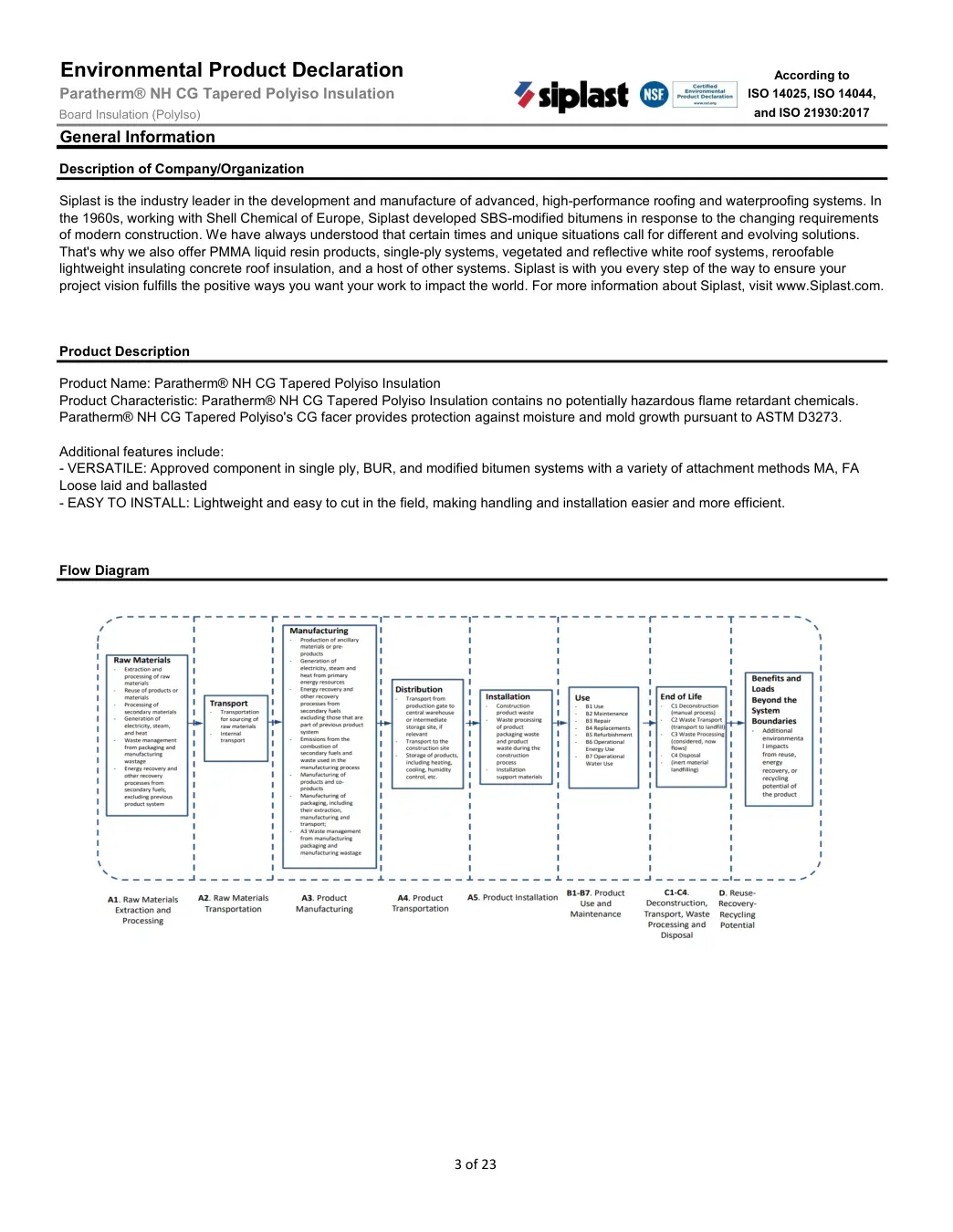
Environmental Product DeclarationBoard Insulation (PolyIso)ISO 14025, ISO 14044,Paratherm® NH CG Tapered Polyiso InsulationAccording toand ISO 21930:2017Description of Company/OrganizationSiplast is the industry leader in the development and manufacture of advanced, high-performance roofing and waterproofing systems. In the 1960s, working with Shell Chemical of Europe, Siplast developed SBS-modified bitumens in response to the changing requirements of modern construction. We have always understood that certain times and unique situations call for different and evolving solutions. That's why we also offer PMMA liquid resin products, single-ply systems, vegetated and reflective white roof systems, reroofable lightweight insulating concrete roof insulation, and a host of other systems. Siplast is with you every step of the way to ensure your project vision fulfills the positive ways you want your work to impact the world. For more information about Siplast, visit www.Siplast.com.Product DescriptionFlow DiagramProduct Name: Paratherm® NH CG Tapered Polyiso InsulationProduct Characteristic: Paratherm® NH CG Tapered Polyiso Insulation contains no potentially hazardous flame retardant chemicals. Paratherm® NH CG Tapered Polyiso's CG facer provides protection against moisture and mold growth pursuant to ASTM D3273. Additional features include: - VERSATILE: Approved component in single ply, BUR, and modified bitumen systems with a variety of attachment methods MA, FA Loose laid and ballasted - EASY TO INSTALL: Lightweight and easy to cut in the field, making handling and installation easier and more efficient.General Information3 of 23
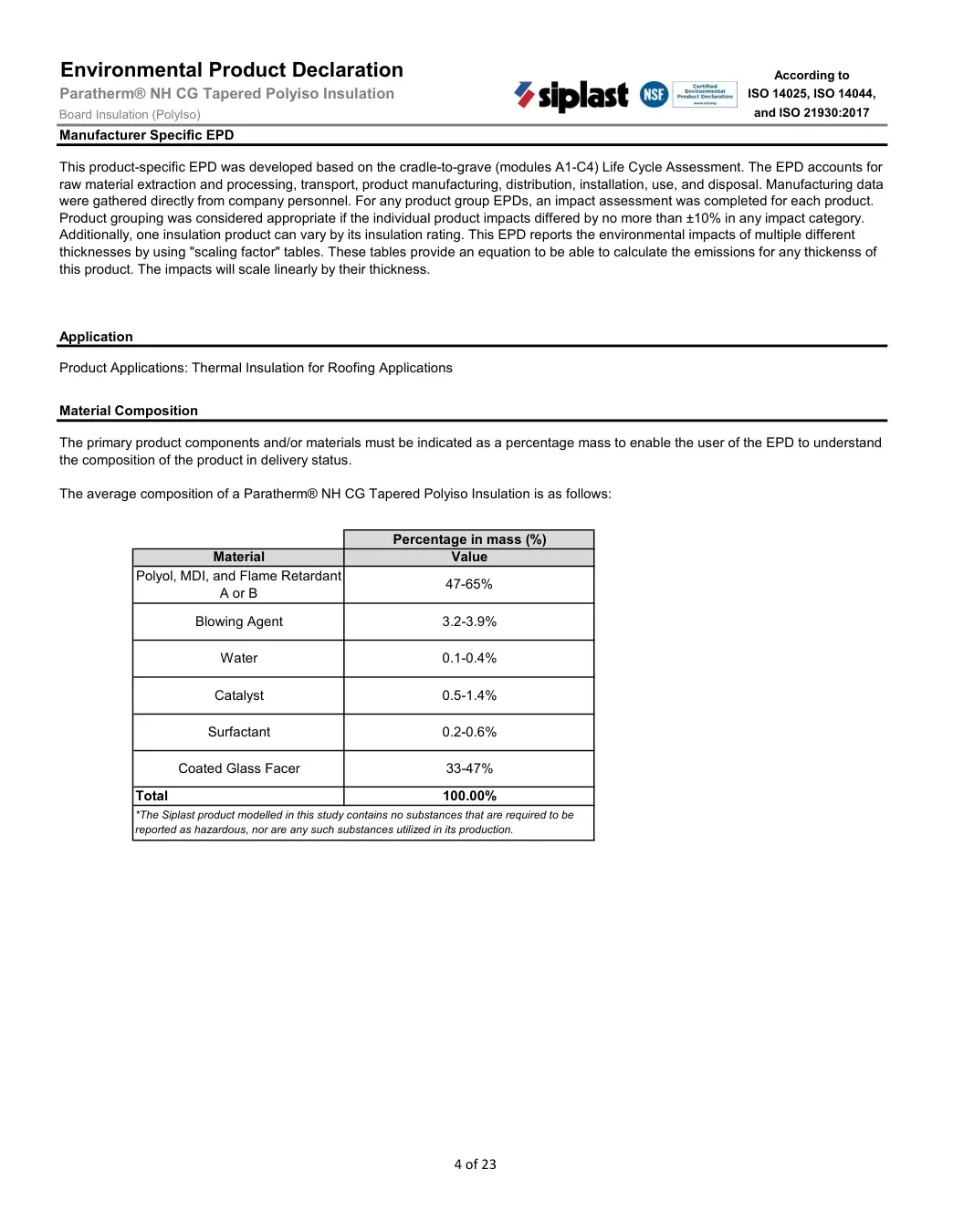
Environmental Product DeclarationBoard Insulation (PolyIso)ISO 14025, ISO 14044,Paratherm® NH CG Tapered Polyiso InsulationAccording toand ISO 21930:2017ValueMaterial100.00%Blowing Agent3.2-3.9%Water0.1-0.4%Catalyst0.5-1.4%Surfactant0.2-0.6%Coated Glass FacerTotalThis product-specific EPD was developed based on the cradle-to-grave (modules A1-C4) Life Cycle Assessment. The EPD accounts for raw material extraction and processing, transport, product manufacturing, distribution, installation, use, and disposal. Manufacturing data were gathered directly from company personnel. For any product group EPDs, an impact assessment was completed for each product. Product grouping was considered appropriate if the individual product impacts differed by no more than ±10% in any impact category.Additionally, one insulation product can vary by its insulation rating. This EPD reports the environmental impacts of multiple different thicknesses by using "scaling factor" tables. These tables provide an equation to be able to calculate the emissions for any thickenss of this product. The impacts will scale linearly by their thickness.33-47%ApplicationProduct Applications: Thermal Insulation for Roofing ApplicationsMaterial CompositionThe primary product components and/or materials must be indicated as a percentage mass to enable the user of the EPD to understand the composition of the product in delivery status. The average composition of a Paratherm® NH CG Tapered Polyiso Insulation is as follows:*The Siplast product modelled in this study contains no substances that are required to be reported as hazardous, nor are any such substances utilized in its production.Percentage in mass (%)Manufacturer Specific EPDPolyol, MDI, and Flame Retardant A or B47-65%4 of 23
Environmental Product DeclarationBoard Insulation (PolyIso)ISO 14025, ISO 14044,Paratherm® NH CG Tapered Polyiso InsulationAccording toand ISO 21930:2017Properties of Declared Product as ShippedAfter manufacturing, the product is packaged for shipment to the customer. Packaging includes a plastic film that wraps around the entire product. This may be recyclable in some markets, but for the purposes of this EPD it is assumed to be landfilled. Product is available in 4' x 4' (1.22 m x 1.22 m) and 4' x 8' (1.22 m x 2.44 m) boards. Available in a variety of thicknesses from 0.5" (12.7 mm) to 4.5" (114.3 mm).Placing on the Market / Application RulesThe standards and criteria that can be applied for Paratherm® NH CG Tapered Polyiso Insulation are: - Meets the requirements of ASTM C1289 Type II, Class 2, Grade 2 (20 psi), and available in Grade 3 (25 psi)- FM Approved- Classified by UL in accordance with ANSI/UL 1256, UL 790, and UL 263.- UL Evaluation Report ER1306-03- Miami-Dade County Product Control Approved- State of Florida Approved5 of 23
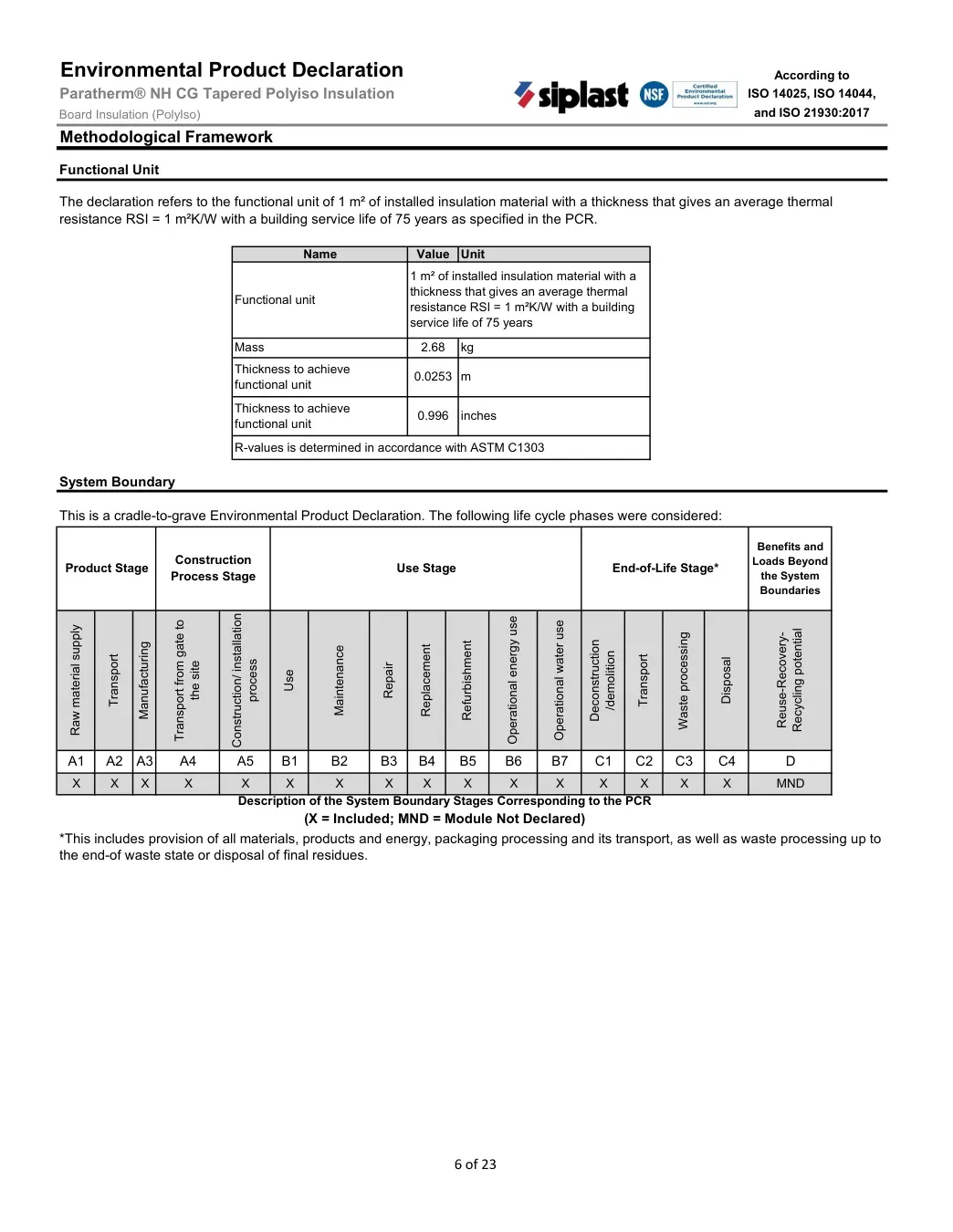
Environmental Product DeclarationBoard Insulation (PolyIso)ISO 14025, ISO 14044,Paratherm® NH CG Tapered Polyiso InsulationAccording toand ISO 21930:2017B7C4C3A2B4Description of the System Boundary Stages Corresponding to the PCRX*This includes provision of all materials, products and energy, packaging processing and its transport, as well as waste processing up to the end-of waste state or disposal of final residues. MND(X = Included; MND = Module Not Declared)Construction/ installation processOperational water useB2C1Reuse-Recovery-Recycling potentialXA3B3XXC2XA5B6XXB1XB5A1XDXXA40.996inchesXXXReplacementRefurbishmentOperational energy useTransportXXR-values is determined in accordance with ASTM C1303The declaration refers to the functional unit of 1 m² of installed insulation material with a thickness that gives an average thermal resistance RSI = 1 m²K/W with a building service life of 75 years as specified in the PCR.1 m² of installed insulation material with a thickness that gives an average thermal resistance RSI = 1 m²K/W with a building service life of 75 yearsRepairTransport from gate to the siteThickness to achieve functional unit2.68Functional UnitMethodological FrameworkMassFunctional unitThickness to achieve functional unit0.0253ValuekgThis is a cradle-to-grave Environmental Product Declaration. The following life cycle phases were considered:System BoundaryBenefits and Loads Beyond the System BoundariesUse StageEnd-of-Life Stage*UnitRaw material supplyTransportManufacturingMaintenanceWaste processingDisposalProduct StageConstruction Process StagemNameUseDeconstruction /demolition6 of 23
Environmental Product DeclarationBoard Insulation (PolyIso)ISO 14025, ISO 14044,Paratherm® NH CG Tapered Polyiso InsulationAccording toand ISO 21930:2017Reference Service LifeThe use phase follows the installation of polyiso roof insulation boards. In a roofing system, the insulation is located on top of a roof deck and below the roof membrane. The roof membrane when installed properly and adequately maintained, protects the insulation from the environmental elements and weather during its use. Therefore, it is expected that polyiso will not sustain damage that affects its performance and function, and does not require maintenance. As defined in the governing PCR, the Building Estimated Service Life (ESL) is 75 years. The necessary steps for providing weather protection are specified by manufacturer installation instructions and are mandated by model building codes. The roof membrane’s useful life span is influenced by many variables including roof system design, quality of the installation, type and durability of the membrane, roof system component configuration and maintenance as well as weather conditions and events. However, the real world reroofing scenarios, building owner tendencies, and the expected service life of roof membranes all indicate that reroofing activity will take place during the 75-year building ESL. Reroofing activity may initially occur at 15-30 years after the installation of the original system and driven by recurring roof leaks that cannot be remedied by patch repairs of the membrane. When reroofing is required, options are available to address the need for a new roof membrane without the need to replace the insulation. The model building codes describe a “Roof Recover” as an acceptable reroofing practice, which occurs when a new roof covering is installed on top of the existing roof system without disturbing or removing the existing roof covering or the insulation below. Roof Recover, as defined by industry practices, involves visual examination and appropriate testing to ensure that all roof components, including insulation, have not sustained damage or deterioration. This approach allows the insulation to be reused instead of being disposed of into a landfill. The Roof Recover approach is a common practice in the roofing industry, it is permitted by model building codes, and allows the service life of a roof system to be extended (without the need to replace the insulation). Although the Roof Recover approach is a common practice, it is often not captured in reroofing studies available in the public domain, which typically contemplate a full roof replacement. Pertinent to this declaration, we recognize a 20-year life span for the original installation of the membrane followed by a Roof Recover, which extends the life of the original roof system to 40 years. This practice establishes a 40-year RSL for polyiso roof insulation boards with a Roof Recover. The model building codes allow a roof to be recovered only once. Where two roof membranes are installed on an existing roof, a reroofing process referred to as a “Roof Replacement” is required. This process involves the removal of all roof components down to the roof deck. This study conservatively assumes all insulation is disposed in the landfill during a Roof Replacement. Therefore, the polyiso roof insulation boards’ cradle-to-grave assessment incorporates all life cycle stage environmental impacts connected with the original building construction, a Roof Recover operation at 20-years, as well as the building’s Roof Replacement operation at 40-years. This translates to 1.9 replacement cycles during the 75-year building ESL (75-year ESL/40-year RSL = 1.9 replacement cycles).Allocation was determined on a mass basis. Since multiple facilities produced these products, a weighted average by production mass was used to determine manufacturing inputs. When facilities manufacture additional product types, facility allocation is done based on mass of production. No co-products are produced, so no co-product allocation was performed.Allocation7 of 23
Environmental Product DeclarationBoard Insulation (PolyIso)ISO 14025, ISO 14044,Paratherm® NH CG Tapered Polyiso InsulationAccording toand ISO 21930:2017Treatment of Biogenic CarbonThe uptake and release of biogenic carbon throughout the product life cycle follows ISO 21930:2017 Section 7.2.7.Data QualityCut-off CriteriaThe period under review is the full calendar year of 2021.The data sources used are complete and representative of global systems in terms of the geographic and technological coverage and are a recent vintage (i.e., less than ten years old). The data used for primary data are based on direct information sources of the manufacturers. Secondary data sets were used for raw materials extraction and processing, end of life, transportation, and energy production flows. Wherever secondary data is used, the study adopts critically reviewed data for consistency, precision, and reproducibility to limit uncertainty. When a material is not available in the available LCI databases, another chemical which has similar manufacturing and environmental impacts may be used as a proxy, representing the actual chemical. Please see Appendix A in the LCA report for the full breakdown of the data sources. Important data quality factors include precision (measured, calculated, or estimated), completeness (e.g., unreported emissions or excluded flows), consistency (uniformity of the applied methodology throughout the study), and reproducibility (ability for another researcher reproduce the results based on the methodological information provided). Each dataset has an overall rating from one to four, one being “very good” and four being “poor.” The individual datasets were scored and aggregated to determine the data has an overall average rating of 2.1, which is considered good.Period Under ReviewProcesses whose total contribution to the final result, with respect to their mass and in relation to all considered impact categories, is less than 1% can be neglected. The sum of the neglected processes may not exceed 5% by mass of the considered impact categories. For that a documented assumption is admissible.For Hazardous Substances the following requirements apply: • The Life Cycle Inventory (LCI) of hazardous substances will be included, if the inventory is available. • If the LCI for a hazardous substance is not available, the substance will appear as an input in the LCI of the product. • If the LCI of a hazardous substance is approximated by modeling another substance, documentation will be provided.This EPD is in compliance with the cut-off criteria. No processes were neglected or excluded. Capital items for the production processes (machine, buildings, etc.) were not taken into consideration.Data SourcesPrimary data were collected for every process in the product system under the control of Siplast. Secondary data from the Sphera and USLCI databases were utilized when necessary. These data were evaluated and have temporal, geographic, and technical coverage appropriate to the scope of the product category.8 of 23
Environmental Product DeclarationBoard Insulation (PolyIso)ISO 14025, ISO 14044,Paratherm® NH CG Tapered Polyiso InsulationAccording toand ISO 21930:2017Comparability and BenchmarkingA comparison or an evaluation of EPD data is only possible if all data sets to be compared were created according to ISO 21930 and the building context, respectively the product-specific characteristics of performance, are taken into account. Environmental declarations from different programs may not be comparable. When comparing EPDs created using this PCR, variations and deviations are possible. Example of variations: Different LCA software and background LCI datasets may lead to different results for upstream or downstream of the life cycle stages declared. In order to support comparative assertions, this EPD meets all comparability requirements stated in ISO 14025:2006. However, differences in certain assumptions, data quality, and variability between LCA data sets may still exist. As such, caution should be exercised when evaluating EPDs from different manufacturers as the EPD results may. These six impact categories are globally deemed mature enough to be included in Type III environmental declarations. Other categories are being developed and defined and LCA should continue making advances in their development, however the EPD users shall not use additional measures for comparative purposes. Third party verified ISO 14040/44 secondary LCI data sets contribute more than 67% of total impact (either at the unit process level or in aggregate) to any of the required impact categories identified by the applicable PCR.UnitsThe LCA results within this EPD are reported in SI units.9 of 23
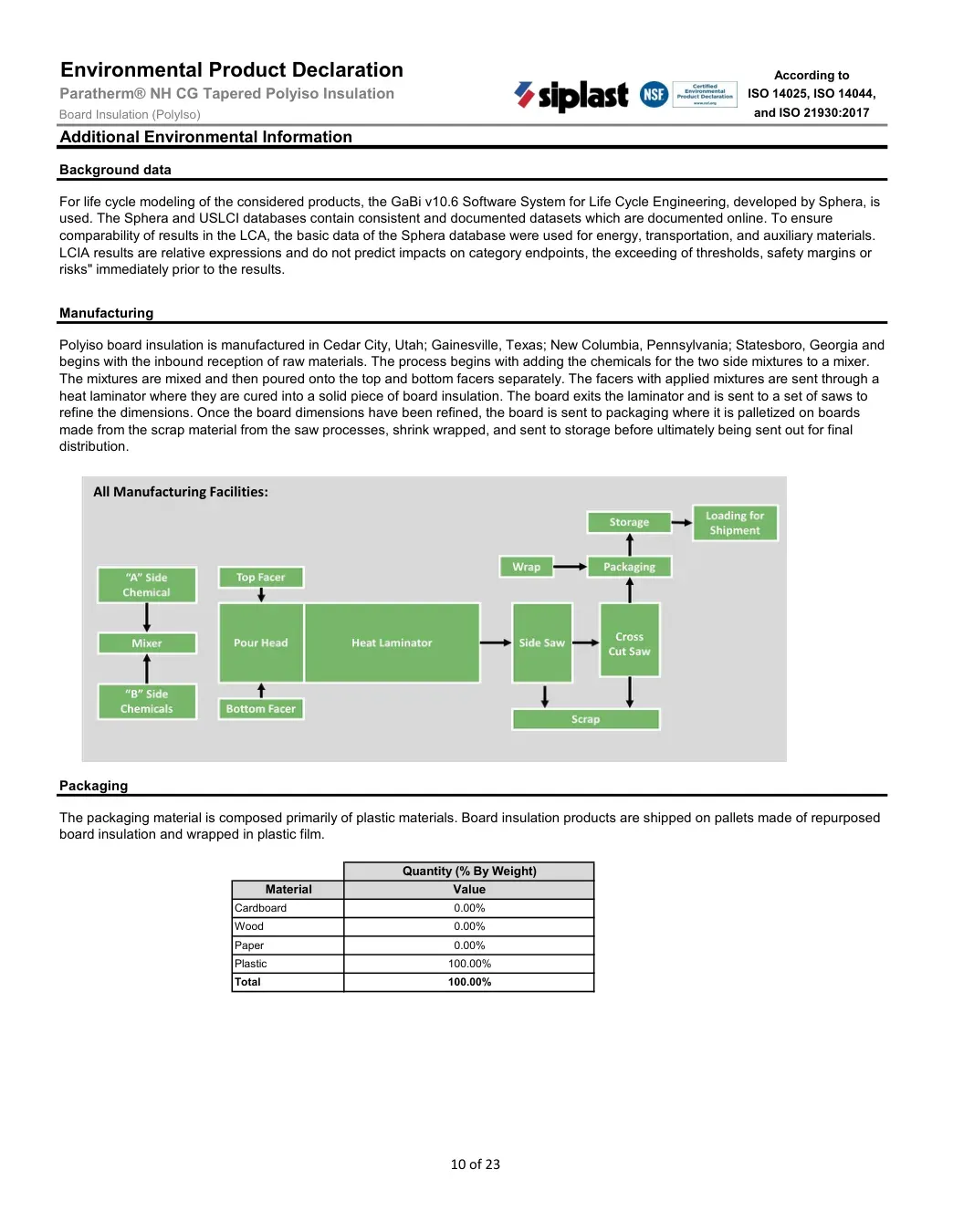
Environmental Product DeclarationBoard Insulation (PolyIso)ISO 14025, ISO 14044,Paratherm® NH CG Tapered Polyiso InsulationAccording toand ISO 21930:2017The packaging material is composed primarily of plastic materials. Board insulation products are shipped on pallets made of repurposed board insulation and wrapped in plastic film.PackagingQuantity (% By Weight)Value0.00%0.00%0.00%100.00%Total100.00%MaterialCardboardPlasticWoodPaperBackground dataAdditional Environmental InformationManufacturingPolyiso board insulation is manufactured in Cedar City, Utah; Gainesville, Texas; New Columbia, Pennsylvania; Statesboro, Georgia and begins with the inbound reception of raw materials. The process begins with adding the chemicals for the two side mixtures to a mixer. The mixtures are mixed and then poured onto the top and bottom facers separately. The facers with applied mixtures are sent through a heat laminator where they are cured into a solid piece of board insulation. The board exits the laminator and is sent to a set of saws to refine the dimensions. Once the board dimensions have been refined, the board is sent to packaging where it is palletized on boards made from the scrap material from the saw processes, shrink wrapped, and sent to storage before ultimately being sent out for final distribution.For life cycle modeling of the considered products, the GaBi v10.6 Software System for Life Cycle Engineering, developed by Sphera, is used. The Sphera and USLCI databases contain consistent and documented datasets which are documented online. To ensure comparability of results in the LCA, the basic data of the Sphera database were used for energy, transportation, and auxiliary materials. LCIA results are relative expressions and do not predict impacts on category endpoints, the exceeding of thresholds, safety margins or risks" immediately prior to the results. All Manufacturing Facilities:10 of 23
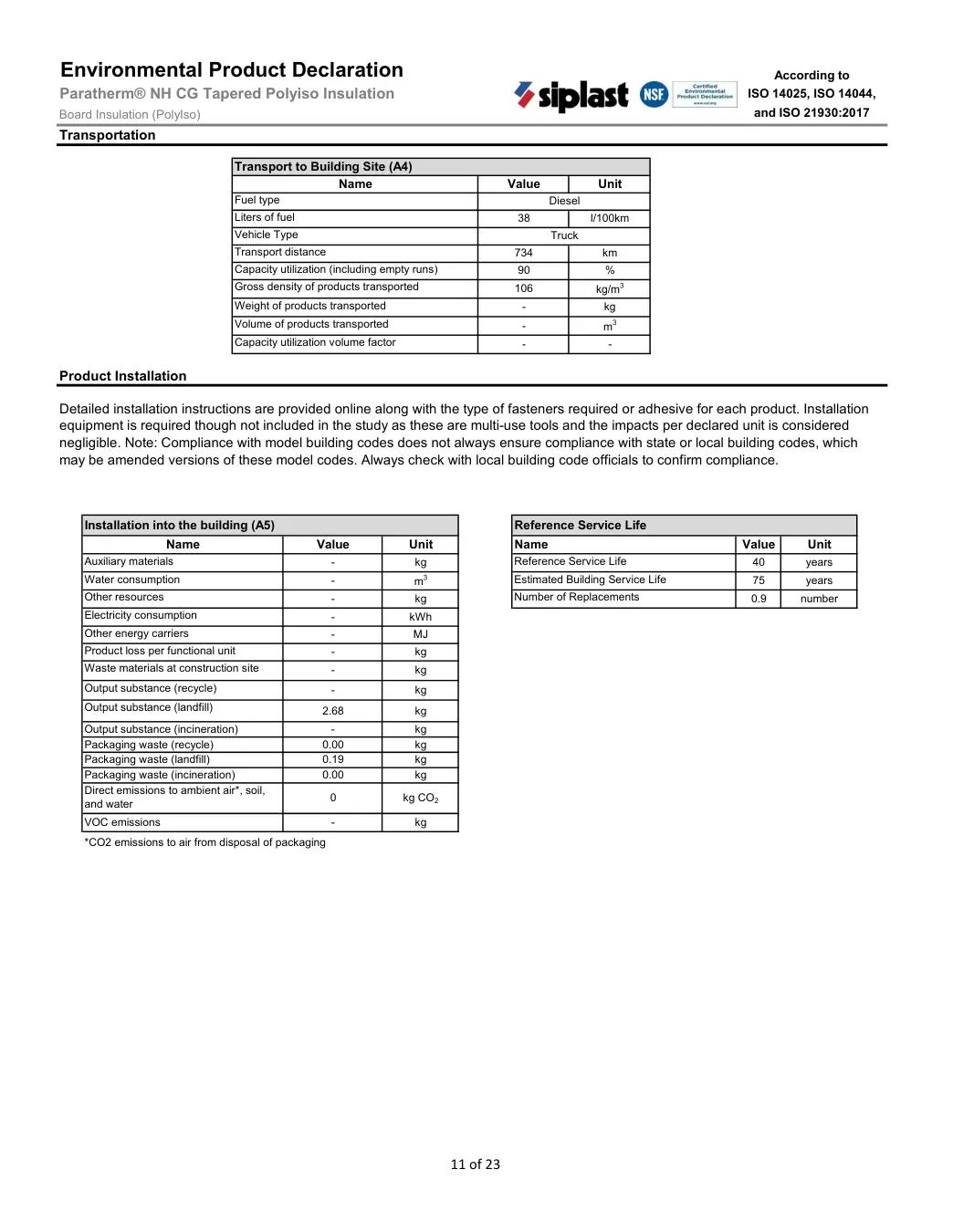
Environmental Product DeclarationBoard Insulation (PolyIso)ISO 14025, ISO 14044,Paratherm® NH CG Tapered Polyiso InsulationAccording toand ISO 21930:2017*CO2 emissions to air from disposal of packagingCapacity utilization (including empty runs)106--Value-2.68VOC emissions0.9kgkgnumberkgkg CO2Detailed installation instructions are provided online along with the type of fasteners required or adhesive for each product. Installation equipment is required though not included in the study as these are multi-use tools and the impacts per declared unit is considered negligible. Note: Compliance with model building codes does not always ensure compliance with state or local building codes, which may be amended versions of these model codes. Always check with local building code officials to confirm compliance.TransportationCapacity utilization volume factor3873490Transport distanceLiters of fuelInstallation into the building (A5)UnitUnit%kg/m3NameDieselkgReference Service Life Packaging waste (incineration)Direct emissions to ambient air*, soil, and waterkgOutput substance (landfill)0.000.190.00---Gross density of products transportedTransport to Building Site (A4)-l/100kmkm0Electricity consumptionOther energy carriersProduct loss per functional unitWaste materials at construction sitekWhVolume of products transportedkgkgUnit-Output substance (incineration)Packaging waste (recycle)kgValue-----kgyearsPackaging waste (landfill)m3Fuel typeWeight of products transportedWater consumptionOther resourcesyearskg40-NameValuekgm3Product InstallationkgEstimated Building Service LifeMJOutput substance (recycle)75Number of ReplacementsVehicle TypeTruckNameReference Service Life Auxiliary materials11 of 23
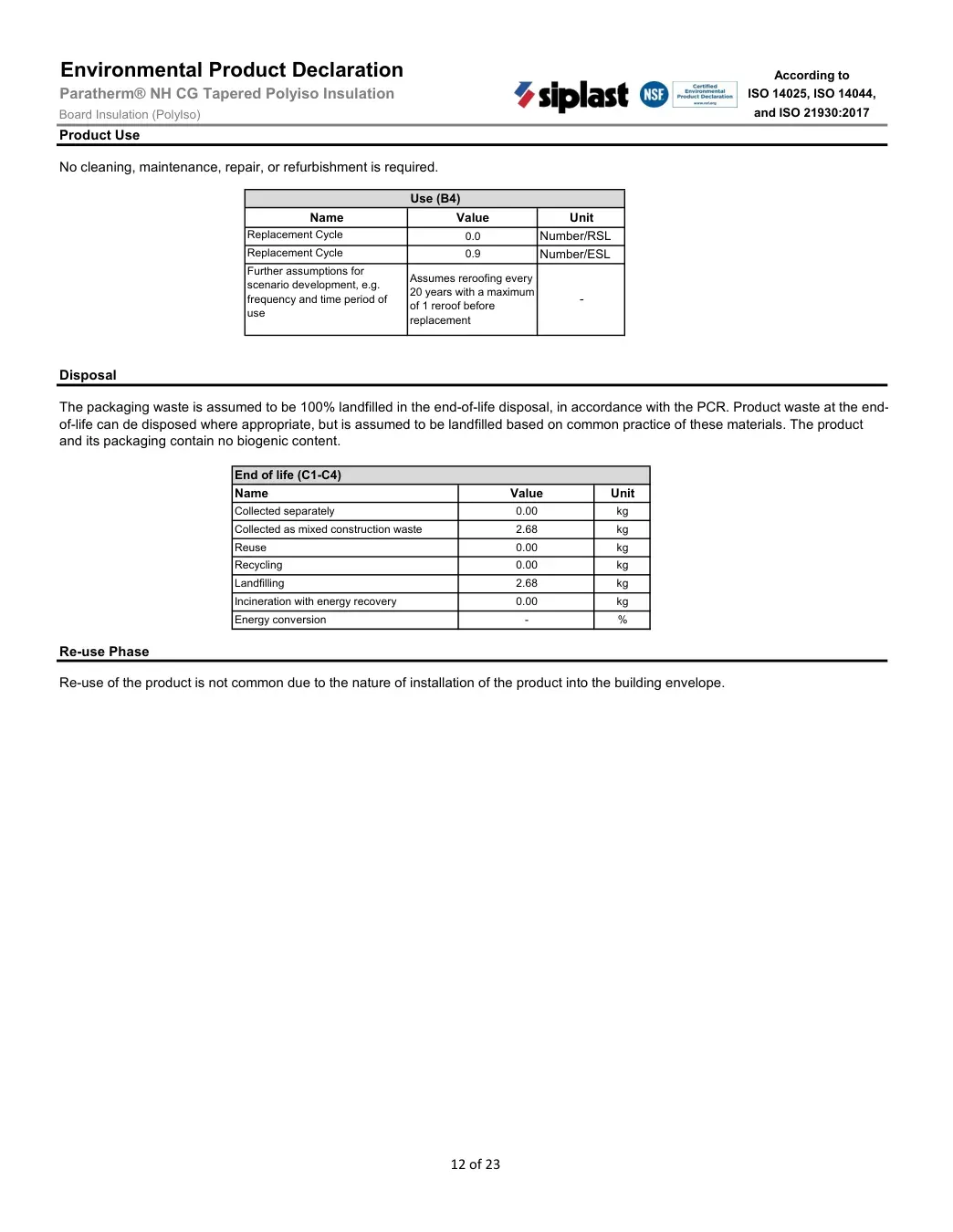
Environmental Product DeclarationBoard Insulation (PolyIso)ISO 14025, ISO 14044,Paratherm® NH CG Tapered Polyiso InsulationAccording toand ISO 21930:2017Use (B4)No cleaning, maintenance, repair, or refurbishment is required. ValueEnd of life (C1-C4)Product Use0.00Re-use PhaseCollected as mixed construction wasteCollected separatelyReusekg0.002.68NamekgUnitkgRecyclingDisposal2.680.00-kg%Incineration with energy recoverykgLandfillingEnergy conversion0.00kgRe-use of the product is not common due to the nature of installation of the product into the building envelope.The packaging waste is assumed to be 100% landfilled in the end-of-life disposal, in accordance with the PCR. Product waste at the end-of-life can de disposed where appropriate, but is assumed to be landfilled based on common practice of these materials. The product and its packaging contain no biogenic content.NameValueUnitReplacement Cycle0.0Number/RSLReplacement Cycle0.9Number/ESLFurther assumptions for scenario development, e.g. frequency and time period of useAssumes reroofing every 20 years with a maximum of 1 reroof before replacement-12 of 23
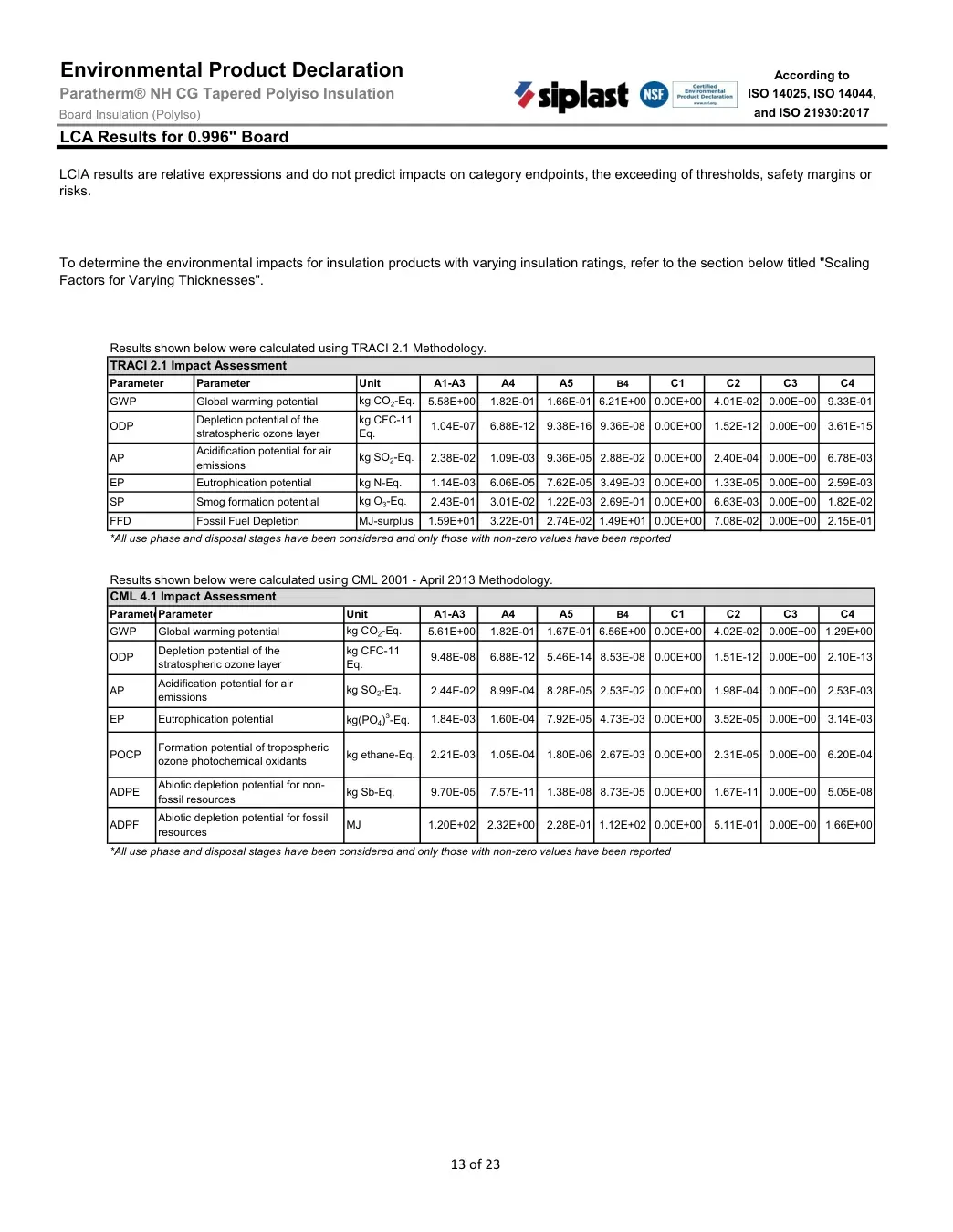
Environmental Product DeclarationBoard Insulation (PolyIso)ISO 14025, ISO 14044,Paratherm® NH CG Tapered Polyiso InsulationAccording toand ISO 21930:2017Results shown below were calculated using TRACI 2.1 Methodology.Results shown below were calculated using CML 2001 - April 2013 Methodology.TRACI 2.1 Impact AssessmentCML 4.1 Impact AssessmentUnit0.00E+00kg CO2-Eq.kg CFC-11 Eq.A52.53E-024.73E-032.67E-038.73E-053.49E-032.69E-011.49E+016.88E-12Global warming potentialDepletion potential of the stratospheric ozone layer9.48E-086.88E-125.46E-140.00E+00GWPEPPOCPB41.12E+021.33E-051.14E-036.06E-056.21E+009.36E-082.88E-02C32.40E-041.09E-038.53E-08Fossil Fuel DepletionAcidification potential for air emissionskg SO2-Eq.kg N-Eq.kg O3-Eq.MJ-surplus0.00E+000.00E+00A51.66E-01APDepletion potential of the stratospheric ozone layerUnit1.82E-01A1-A35.58E+001.04E-07A4Eutrophication potentialSmog formation potential9.38E-169.36E-05ODPAPC10.00E+000.00E+00C24.01E-022.38E-02A41.82E-01C2C10.00E+007.08E-021.22E-036.63E-030.00E+00A1-A31.52E-121.59E+012.43E-010.00E+000.00E+000.00E+000.00E+00ParameterADPE1.82E-022.15E-01*All use phase and disposal stages have been considered and only those with non-zero values have been reportedParameteParameterSPFFD5.61E+001.67E-010.00E+000.00E+00B46.56E+003.01E-024.02E-020.00E+007.92E-053.52E-05ADPF0.00E+003.22E-012.74E-02ParameterGWP0.00E+001.20E+022.32E+005.11E-010.00E+002.28E-01C30.00E+00C49.33E-013.61E-155.05E-08LCA Results for 0.996" BoardTo determine the environmental impacts for insulation products with varying insulation ratings, refer to the section below titled "Scaling Factors for Varying Thicknesses".0.00E+008.99E-047.62E-05EP6.78E-032.59E-032.53E-031.51E-12kg SO2-Eq.Formation potential of tropospheric ozone photochemical oxidantsAbiotic depletion potential for non-fossil resourcesAbiotic depletion potential for fossil resourceskg(PO4)3-Eq.kg ethane-Eq.kg Sb-Eq.MJ*All use phase and disposal stages have been considered and only those with non-zero values have been reported8.28E-051.98E-04Acidification potential for air emissionsEutrophication potentialODPkg CO2-Eq.kg CFC-11 Eq.C40.00E+003.14E-032.21E-031.05E-041.80E-060.00E+002.31E-050.00E+006.20E-049.70E-057.57E-111.38E-080.00E+001.67E-110.00E+001.29E+001.84E-031.60E-040.00E+00Global warming potential1.66E+002.10E-132.44E-02LCIA results are relative expressions and do not predict impacts on category endpoints, the exceeding of thresholds, safety margins or risks.13 of 23
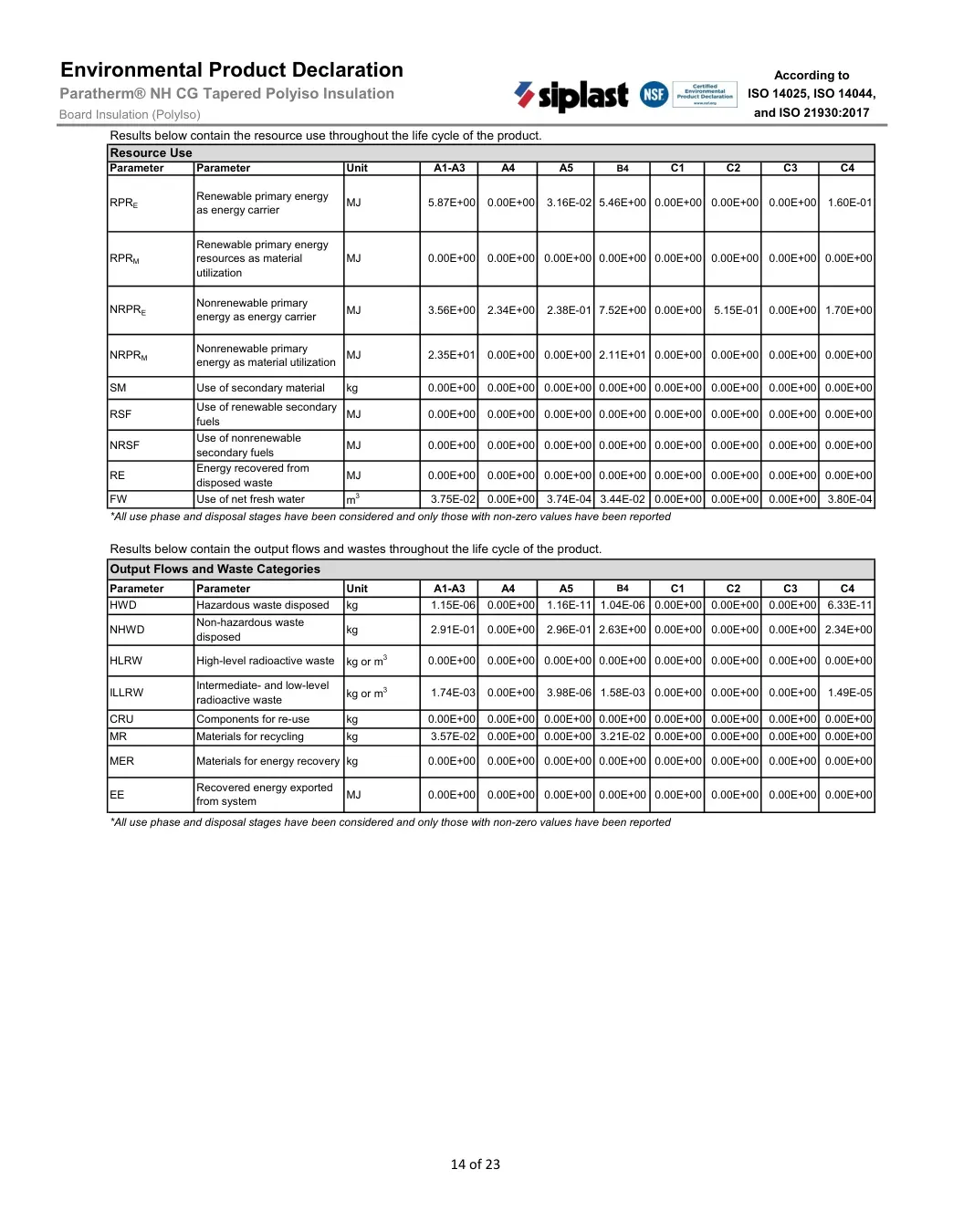
Environmental Product DeclarationBoard Insulation (PolyIso)ISO 14025, ISO 14044,Paratherm® NH CG Tapered Polyiso InsulationAccording toand ISO 21930:2017Results below contain the resource use throughout the life cycle of the product.Results below contain the output flows and wastes throughout the life cycle of the product.Resource UseOutput Flows and Waste CategoriesB41.04E-06Recovered energy exported from systemkgMJNon-hazardous waste disposed2.63E+000.00E+001.58E-030.00E+000.00E+000.00E+007.52E+002.11E+010.00E+000.00E+00m3UnitUse of renewable secondary fuelsUse of nonrenewable secondary fuelsEnergy recovered from disposed wasteUse of net fresh waterkgkgkg or m3A42.96E-010.00E+000.00E+000.00E+000.00E+00C3C1ParameterHWDNHWDHLRWILLRWRPRMNRPRENRPRMREFWParameterRenewable primary energy as energy carrierRenewable primary energy resources as material utilizationA51.15E-060.00E+000.00E+000.00E+000.00E+00Nonrenewable primary energy as material utilizationUse of secondary materialB45.46E+00C30.00E+00UnitMJMJ2.35E+013.74E-04*All use phase and disposal stages have been considered and only those with non-zero values have been reportedHazardous waste disposed0.00E+000.00E+000.00E+00 0.00E+000.00E+00SMRSFNRSFMJMJHigh-level radioactive wasteIntermediate- and low-level radioactive wasteComponents for re-useMaterials for recyclingMaterials for energy recoveryCRU1.16E-11MJMJkgNonrenewable primary energy as energy carrier0.00E+000.00E+000.00E+000.00E+000.00E+000.00E+005.87E+00A1-A3A4A5C1C23.16E-020.00E+000.00E+000.00E+000.00E+001.60E-010.00E+003.75E-020.00E+00MJ*All use phase and disposal stages have been considered and only those with non-zero values have been reported0.00E+00ParameterRPREMRMEREE0.00E+000.00E+000.00E+000.00E+000.00E+000.00E+000.00E+00 0.00E+003.56E+002.34E+002.38E-010.00E+005.15E-010.00E+00 1.70E+000.00E+00C40.00E+000.00E+000.00E+000.00E+000.00E+000.00E+000.00E+000.00E+000.00E+000.00E+000.00E+000.00E+000.00E+000.00E+00 0.00E+000.00E+000.00E+000.00E+00 0.00E+003.80E-040.00E+000.00E+000.00E+000.00E+003.44E-020.00E+00C20.00E+000.00E+000.00E+000.00E+000.00E+000.00E+000.00E+000.00E+000.00E+00A1-A30.00E+00kg or m3kgkgParameter0.00E+000.00E+003.57E-020.00E+000.00E+000.00E+000.00E+000.00E+000.00E+000.00E+000.00E+003.21E-020.00E+000.00E+000.00E+000.00E+000.00E+00C46.33E-112.34E+000.00E+001.49E-051.74E-030.00E+003.98E-060.00E+000.00E+000.00E+000.00E+000.00E+000.00E+000.00E+000.00E+000.00E+000.00E+002.91E-010.00E+0014 of 23
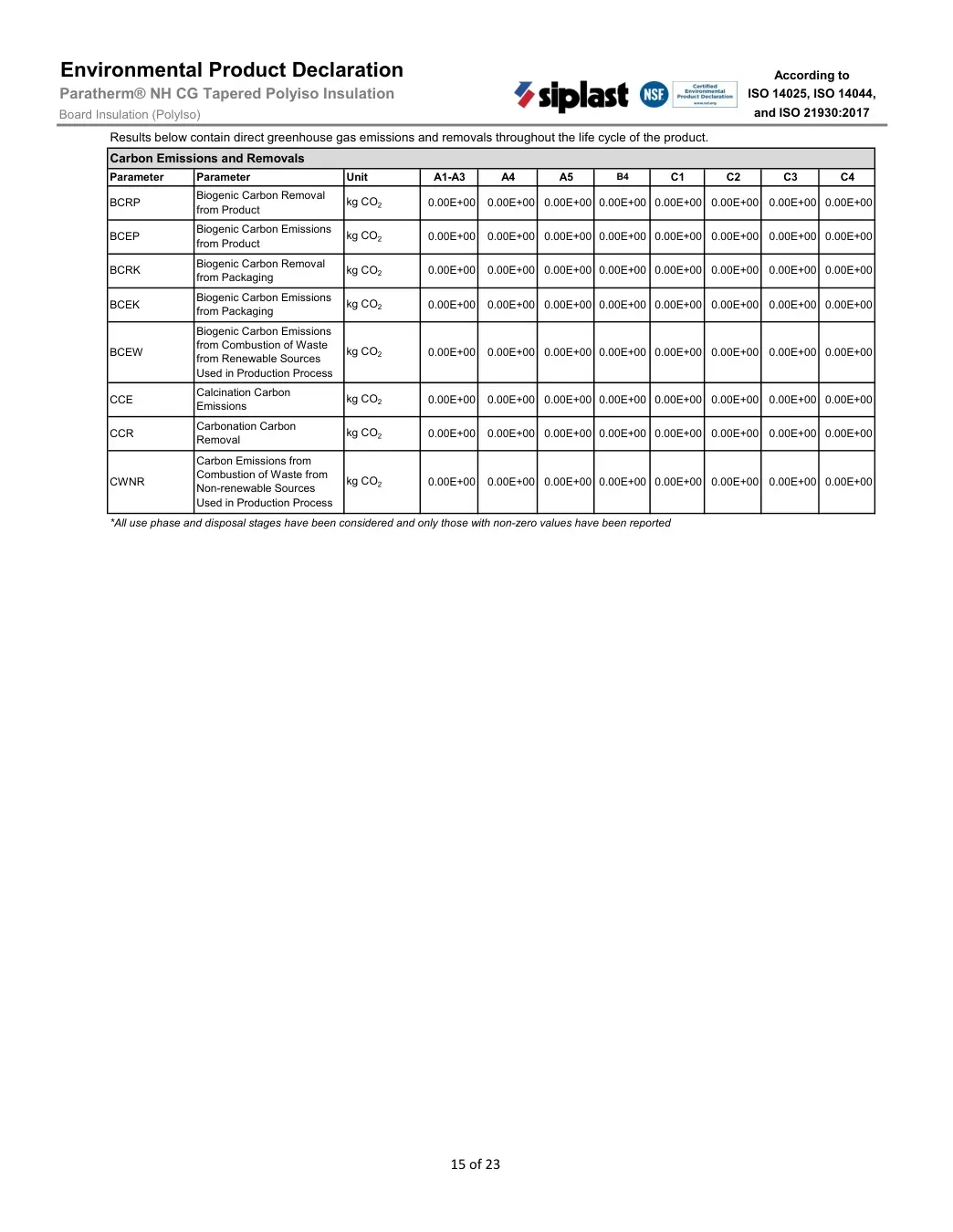
Environmental Product DeclarationBoard Insulation (PolyIso)ISO 14025, ISO 14044,Paratherm® NH CG Tapered Polyiso InsulationAccording toand ISO 21930:20170.00E+000.00E+00Carbon Emissions and RemovalsB40.00E+000.00E+000.00E+000.00E+000.00E+00C20.00E+000.00E+000.00E+00C4kg CO2A1-A3A4Parameterkg CO2kg CO2kg CO2ParameterBCRPBCEPBCRKBCEKBCEWBiogenic Carbon Removal from PackagingBiogenic Carbon Emissions from PackagingCCE0.00E+000.00E+000.00E+000.00E+000.00E+000.00E+00Biogenic Carbon Removal from Product0.00E+000.00E+000.00E+00C10.00E+000.00E+000.00E+000.00E+000.00E+000.00E+000.00E+000.00E+000.00E+00C30.00E+000.00E+000.00E+000.00E+000.00E+000.00E+000.00E+000.00E+000.00E+00kg CO2kg CO2Unitkg CO20.00E+00kg CO20.00E+000.00E+000.00E+000.00E+00A5Biogenic Carbon Emissions from Product0.00E+000.00E+000.00E+000.00E+000.00E+000.00E+000.00E+00CCRCWNRCarbon Emissions from Combustion of Waste from Non-renewable Sources Used in Production Process0.00E+00Biogenic Carbon Emissions from Combustion of Waste from Renewable Sources Used in Production ProcessCalcination Carbon Emissions0.00E+000.00E+000.00E+000.00E+000.00E+000.00E+000.00E+000.00E+000.00E+00Carbonation Carbon Removal0.00E+00*All use phase and disposal stages have been considered and only those with non-zero values have been reportedResults below contain direct greenhouse gas emissions and removals throughout the life cycle of the product.0.00E+000.00E+000.00E+000.00E+0015 of 23
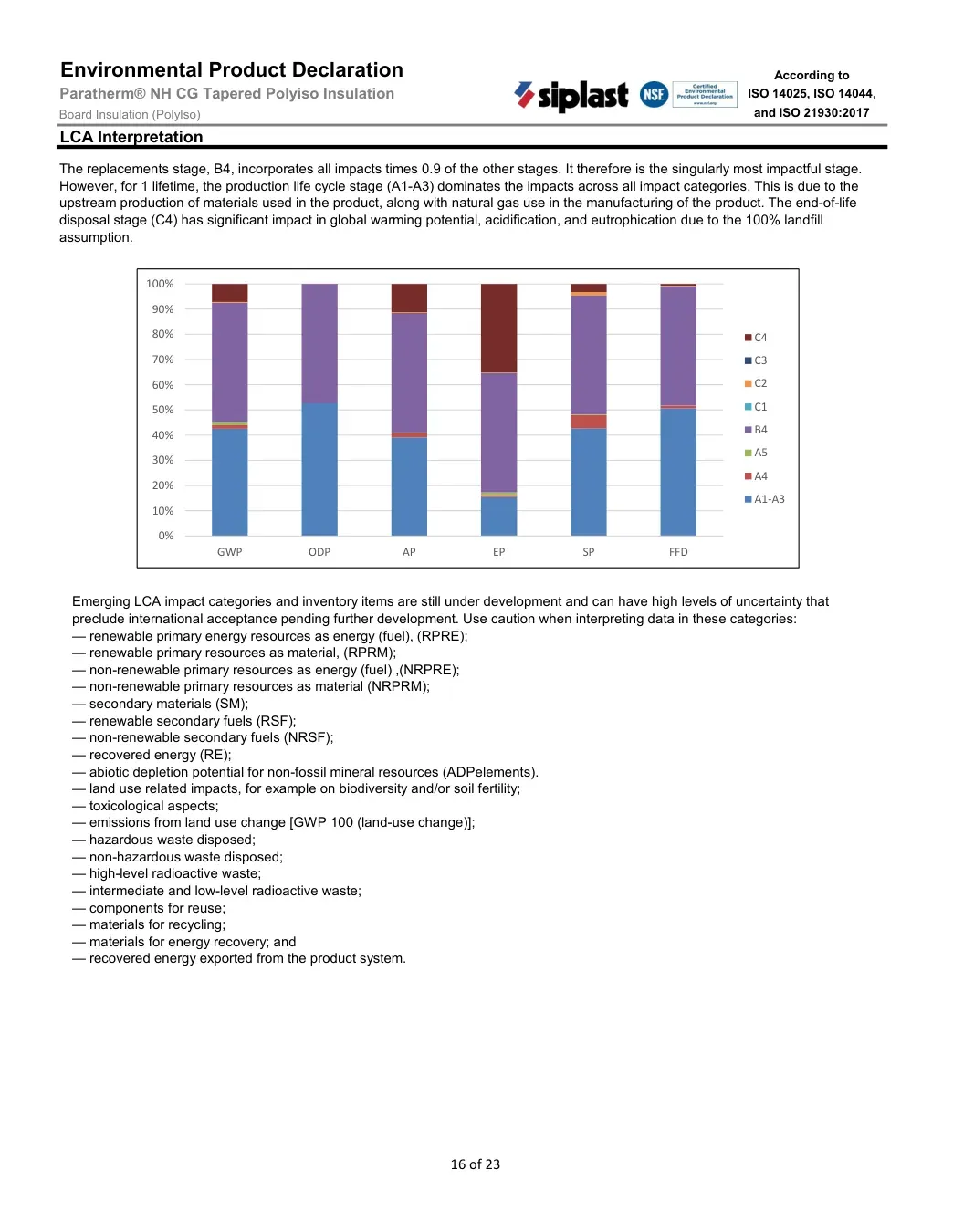
Environmental Product DeclarationBoard Insulation (PolyIso)ISO 14025, ISO 14044,Paratherm® NH CG Tapered Polyiso InsulationAccording toand ISO 21930:2017The replacements stage, B4, incorporates all impacts times 0.9 of the other stages. It therefore is the singularly most impactful stage. However, for 1 lifetime, the production life cycle stage (A1-A3) dominates the impacts across all impact categories. This is due to the upstream production of materials used in the product, along with natural gas use in the manufacturing of the product. The end-of-life disposal stage (C4) has significant impact in global warming potential, acidification, and eutrophication due to the 100% landfill assumption.LCA InterpretationEmerging LCA impact categories and inventory items are still under development and can have high levels of uncertainty that preclude international acceptance pending further development. Use caution when interpreting data in these categories:— renewable primary energy resources as energy (fuel), (RPRE);— renewable primary resources as material, (RPRM);— non-renewable primary resources as energy (fuel) ,(NRPRE);— non-renewable primary resources as material (NRPRM);— secondary materials (SM);— renewable secondary fuels (RSF);— non-renewable secondary fuels (NRSF);— recovered energy (RE);— abiotic depletion potential for non-fossil mineral resources (ADPelements).— land use related impacts, for example on biodiversity and/or soil fertility;— toxicological aspects;— emissions from land use change [GWP 100 (land-use change)];— hazardous waste disposed;— non-hazardous waste disposed;— high-level radioactive waste;— intermediate and low-level radioactive waste;— components for reuse;— materials for recycling;— materials for energy recovery; and— recovered energy exported from the product system.0%10%20%30%40%50%60%70%80%90%100%GWPODPAPEPSPFFDC4C3C2C1B4A5A4A1-A316 of 23
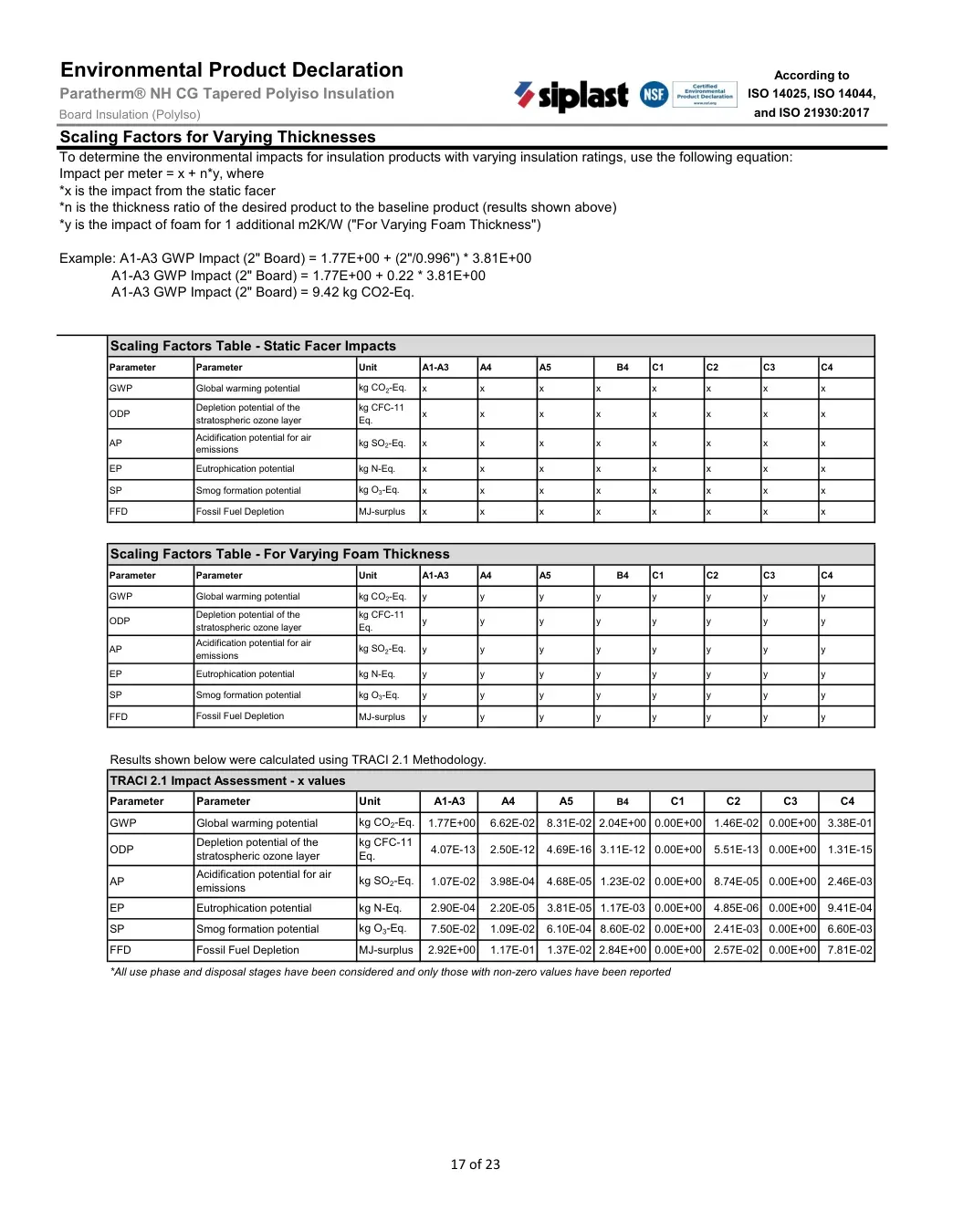
Environmental Product DeclarationBoard Insulation (PolyIso)ISO 14025, ISO 14044,Paratherm® NH CG Tapered Polyiso InsulationAccording toand ISO 21930:2017Results shown below were calculated using TRACI 2.1 Methodology.Scaling Factors Table - Static Facer ImpactsScaling Factors Table - For Varying Foam ThicknessTRACI 2.1 Impact Assessment - x valuesxxxxxyyyyy3.11E-121.23E-021.17E-038.60E-02B4xyODPAPEPSPFFDGlobal warming potentialDepletion potential of the stratospheric ozone layerAcidification potential for air emissionsScaling Factors for Varying Thicknesseskg CO2-Eq.kg CFC-11 Eq.kg SO2-Eq.kg N-Eq.yyyyyyyyyyEPSPxxxA1-A3A4xxxxxParameterGWPxA5C1C2C3To determine the environmental impacts for insulation products with varying insulation ratings, use the following equation:Impact per meter = x + n*y, where*x is the impact from the static facer*n is the thickness ratio of the desired product to the baseline product (results shown above)*y is the impact of foam for 1 additional m2K/W ("For Varying Foam Thickness")Example: A1-A3 GWP Impact (2" Board) = 1.77E+00 + (2"/0.996") * 3.81E+00 A1-A3 GWP Impact (2" Board) = 1.77E+00 + 0.22 * 3.81E+00 A1-A3 GWP Impact (2" Board) = 9.42 kg CO2-Eq.UnitParameterC3kg O3-Eq.MJ-surplusxParameterGWPODPAPxxxxxxyyyyyyyyyyyA1-A3A4A5C1C2B4FFDParameterGlobal warming potentialDepletion potential of the stratospheric ozone layerAcidification potential for air emissionsEutrophication potentialSmog formation potentialFossil Fuel DepletionyyyyyyyyyEutrophication potentialSmog formation potentialFossil Fuel DepletionUnitkg CO2-Eq.kg CFC-11 Eq.kg SO2-Eq.kg N-Eq.kg O3-Eq.MJ-surplusyyyyyyyxxxxxxxxxyyyyyC4xxxxxxxxxC4xxxxxxxxGWPGlobal warming potentialkg CO2-Eq.1.77E+006.62E-028.31E-020.00E+001.46E-020.00E+003.38E-01B42.04E+00ODPDepletion potential of the stratospheric ozone layerkg CFC-11 Eq.4.07E-132.50E-124.69E-160.00E+005.51E-130.00E+001.31E-15ParameterParameterUnitA1-A3A4A5C1C2C3C4APAcidification potential for air emissionskg SO2-Eq.1.07E-023.98E-044.68E-050.00E+008.74E-050.00E+002.46E-03EPEutrophication potentialkg N-Eq.2.90E-042.20E-053.81E-050.00E+004.85E-060.00E+009.41E-04SPSmog formation potentialkg O3-Eq.7.50E-021.09E-026.10E-040.00E+002.41E-030.00E+006.60E-03FFDFossil Fuel DepletionMJ-surplus2.92E+001.17E-011.37E-020.00E+002.57E-020.00E+007.81E-02*All use phase and disposal stages have been considered and only those with non-zero values have been reported2.84E+0017 of 23
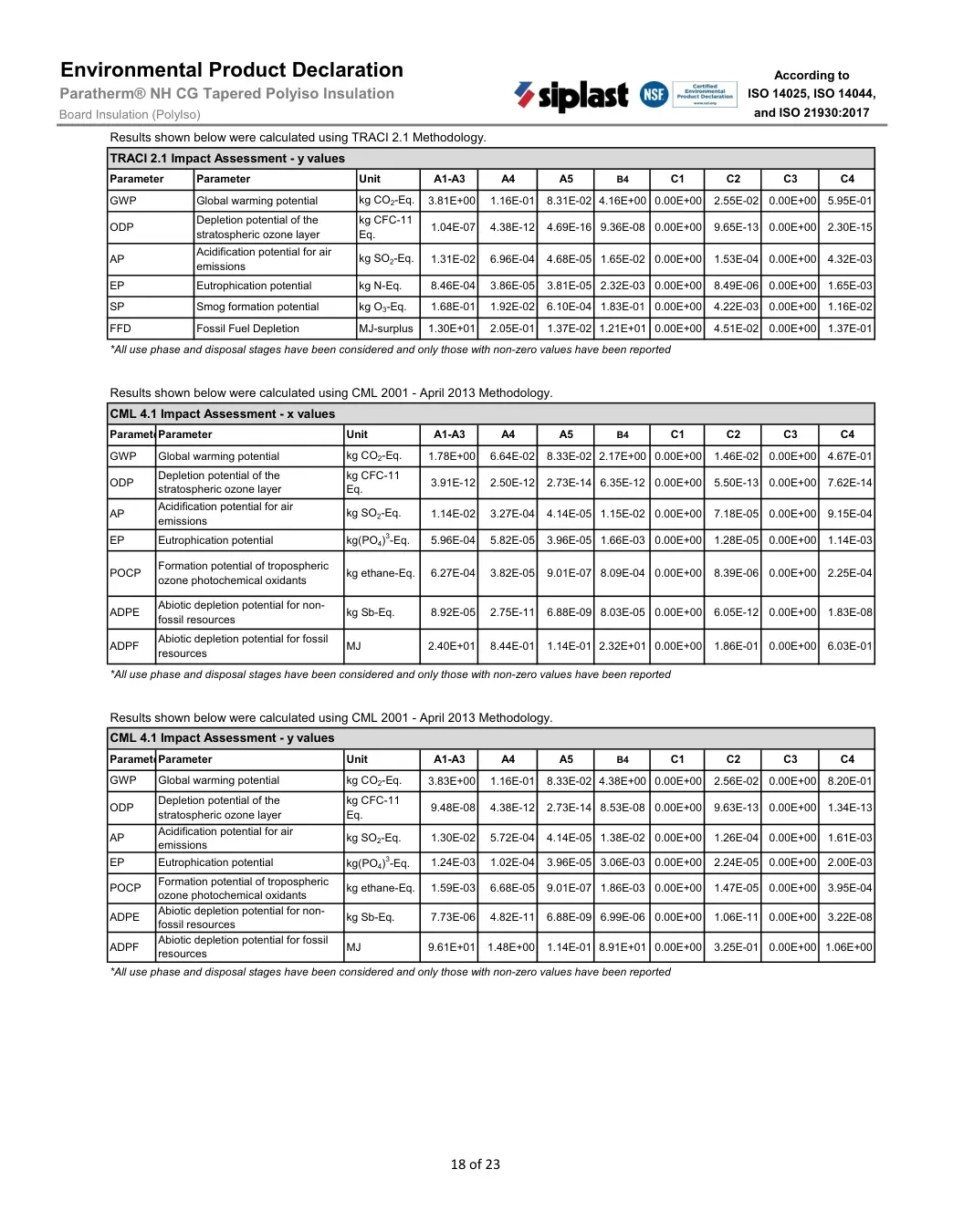
Environmental Product DeclarationBoard Insulation (PolyIso)ISO 14025, ISO 14044,Paratherm® NH CG Tapered Polyiso InsulationAccording toand ISO 21930:2017Results shown below were calculated using TRACI 2.1 Methodology.Results shown below were calculated using CML 2001 - April 2013 Methodology.Results shown below were calculated using CML 2001 - April 2013 Methodology.TRACI 2.1 Impact Assessment - y valuesCML 4.1 Impact Assessment - x valuesParameterParameterUnitA1-A3A4A5C1C2C3C4B4GWPGlobal warming potentialkg CO2-Eq.3.81E+001.16E-018.31E-020.00E+002.55E-020.00E+005.95E-01ODPDepletion potential of the stratospheric ozone layerkg CFC-11 Eq.1.04E-074.38E-124.69E-160.00E+009.65E-130.00E+002.30E-159.36E-084.16E+00APAcidification potential for air emissionskg SO2-Eq.1.31E-026.96E-044.68E-050.00E+001.53E-040.00E+004.32E-03EPEutrophication potentialkg N-Eq.8.46E-043.86E-053.81E-050.00E+008.49E-060.00E+001.65E-031.65E-022.32E-03SPSmog formation potentialkg O3-Eq.1.68E-011.92E-026.10E-040.00E+004.22E-030.00E+001.16E-02FFDFossil Fuel DepletionMJ-surplus1.30E+012.05E-011.37E-020.00E+004.51E-020.00E+001.37E-011.83E-011.21E+01*All use phase and disposal stages have been considered and only those with non-zero values have been reportedParameteParameterUnitA1-A3A4A5C1C2C3C4GWPGlobal warming potentialkg CO2-Eq.1.78E+006.64E-028.33E-020.00E+001.46E-020.00E+004.67E-01B42.17E+00ODPDepletion potential of the stratospheric ozone layerkg CFC-11 Eq.3.91E-122.50E-122.73E-140.00E+005.50E-130.00E+007.62E-14APAcidification potential for air emissionskg SO2-Eq.1.14E-023.27E-044.14E-050.00E+007.18E-050.00E+009.15E-046.35E-121.15E-02EPEutrophication potentialkg(PO4)3-Eq.5.96E-045.82E-053.96E-050.00E+001.28E-050.00E+001.14E-03POCPFormation potential of tropospheric ozone photochemical oxidantskg ethane-Eq.6.27E-043.82E-059.01E-070.00E+008.39E-060.00E+002.25E-041.66E-038.09E-04ADPEAbiotic depletion potential for non-fossil resourceskg Sb-Eq.8.92E-052.75E-116.88E-090.00E+006.05E-120.00E+001.83E-08ADPFAbiotic depletion potential for fossil resourcesMJ2.40E+018.44E-011.14E-010.00E+001.86E-010.00E+006.03E-018.03E-052.32E+01*All use phase and disposal stages have been considered and only those with non-zero values have been reportedParameteParameterUnitA1-A3A4A5C1C2C3C4GWPGlobal warming potentialkg CO2-Eq.3.83E+001.16E-018.33E-020.00E+002.56E-020.00E+008.20E-01CML 4.1 Impact Assessment - y valuesB44.38E+00ODPDepletion potential of the stratospheric ozone layerkg CFC-11 Eq.9.48E-084.38E-122.73E-140.00E+009.63E-130.00E+001.34E-13APAcidification potential for air emissionskg SO2-Eq.1.30E-025.72E-044.14E-050.00E+001.26E-040.00E+001.61E-038.53E-081.38E-02EPEutrophication potentialkg(PO4)3-Eq.1.24E-031.02E-043.96E-050.00E+002.24E-050.00E+002.00E-03POCPFormation potential of tropospheric ozone photochemical oxidantskg ethane-Eq.1.59E-036.68E-059.01E-070.00E+001.47E-050.00E+003.95E-043.06E-031.86E-03ADPEAbiotic depletion potential for non-fossil resourceskg Sb-Eq.7.73E-064.82E-116.88E-090.00E+001.06E-110.00E+003.22E-08ADPFAbiotic depletion potential for fossil resourcesMJ9.61E+011.48E+001.14E-010.00E+003.25E-010.00E+00 1.06E+006.99E-068.91E+01*All use phase and disposal stages have been considered and only those with non-zero values have been reported18 of 23
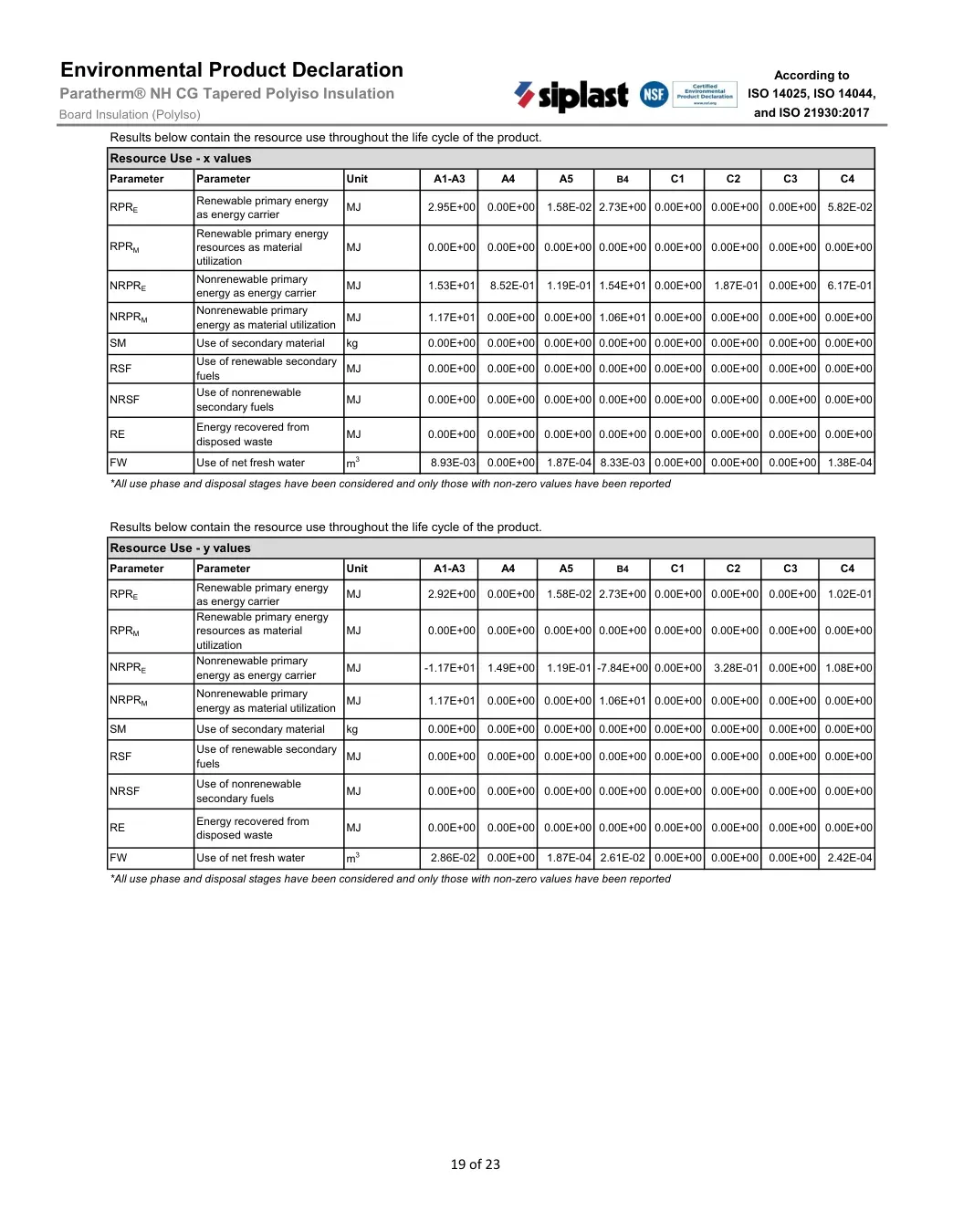
Environmental Product DeclarationBoard Insulation (PolyIso)ISO 14025, ISO 14044,Paratherm® NH CG Tapered Polyiso InsulationAccording toand ISO 21930:2017Results below contain the resource use throughout the life cycle of the product.Results below contain the resource use throughout the life cycle of the product.ParameterParameterUnitA1-A3A4A5C1C2C3C4RPRERenewable primary energy as energy carrierMJ2.95E+000.00E+001.58E-020.00E+000.00E+000.00E+005.82E-02Resource Use - x valuesB42.73E+00RPRMRenewable primary energy resources as material utilizationMJ0.00E+000.00E+000.00E+000.00E+000.00E+000.00E+00 0.00E+00NRPRENonrenewable primary energy as energy carrierMJ1.53E+018.52E-011.19E-010.00E+001.87E-010.00E+006.17E-010.00E+001.54E+01NRPRMNonrenewable primary energy as material utilizationMJ1.17E+010.00E+000.00E+000.00E+000.00E+000.00E+00 0.00E+00SMUse of secondary materialkg0.00E+000.00E+000.00E+000.00E+000.00E+000.00E+00 0.00E+001.06E+010.00E+00RSFUse of renewable secondary fuelsMJ0.00E+000.00E+000.00E+000.00E+000.00E+000.00E+00 0.00E+00NRSFUse of nonrenewable secondary fuelsMJ0.00E+000.00E+000.00E+000.00E+000.00E+000.00E+00 0.00E+000.00E+000.00E+00REEnergy recovered from disposed wasteMJ0.00E+000.00E+000.00E+000.00E+000.00E+000.00E+00 0.00E+00FWUse of net fresh waterm38.93E-030.00E+001.87E-040.00E+000.00E+000.00E+001.38E-040.00E+008.33E-03*All use phase and disposal stages have been considered and only those with non-zero values have been reportedParameterParameterUnitA1-A3A4A5C1C2C3C4RPRERenewable primary energy as energy carrierMJ2.92E+000.00E+001.58E-020.00E+000.00E+000.00E+001.02E-01Resource Use - y valuesB42.73E+00RPRMRenewable primary energy resources as material utilizationMJ0.00E+000.00E+000.00E+000.00E+000.00E+000.00E+00 0.00E+00NRPRENonrenewable primary energy as energy carrierMJ-1.17E+011.49E+001.19E-010.00E+003.28E-010.00E+00 1.08E+000.00E+00-7.84E+00NRPRMNonrenewable primary energy as material utilizationMJ1.17E+010.00E+000.00E+000.00E+000.00E+000.00E+00 0.00E+00SMUse of secondary materialkg0.00E+000.00E+000.00E+000.00E+000.00E+000.00E+00 0.00E+001.06E+010.00E+00RSFUse of renewable secondary fuelsMJ0.00E+000.00E+000.00E+000.00E+000.00E+000.00E+00 0.00E+00NRSFUse of nonrenewable secondary fuelsMJ0.00E+000.00E+000.00E+000.00E+000.00E+000.00E+00 0.00E+000.00E+000.00E+00REEnergy recovered from disposed wasteMJ0.00E+000.00E+000.00E+000.00E+000.00E+000.00E+00 0.00E+00FWUse of net fresh waterm32.86E-020.00E+001.87E-040.00E+000.00E+000.00E+002.42E-040.00E+002.61E-02*All use phase and disposal stages have been considered and only those with non-zero values have been reported19 of 23
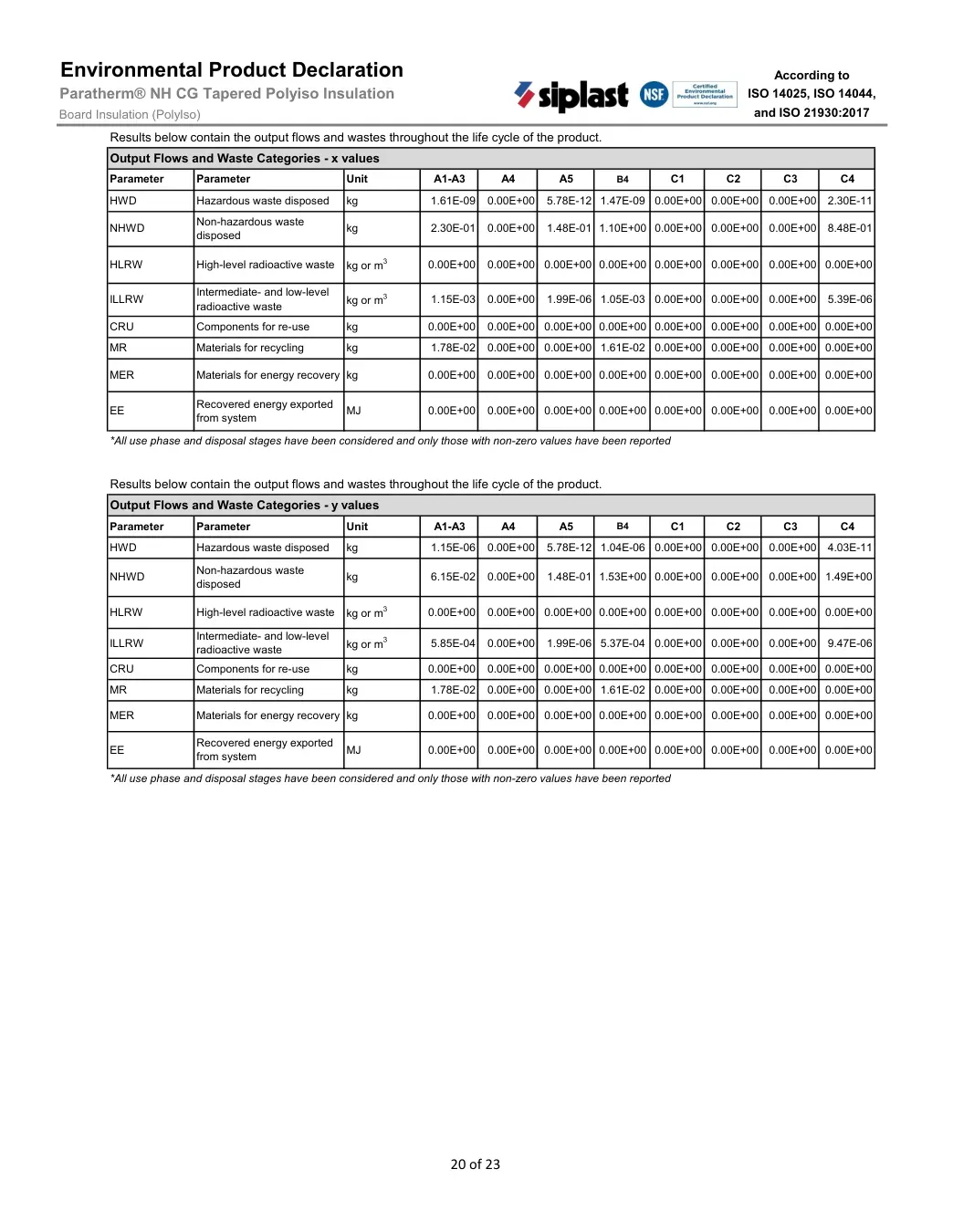
Environmental Product DeclarationBoard Insulation (PolyIso)ISO 14025, ISO 14044,Paratherm® NH CG Tapered Polyiso InsulationAccording toand ISO 21930:2017Results below contain the output flows and wastes throughout the life cycle of the product.Results below contain the output flows and wastes throughout the life cycle of the product.ParameterParameterUnitA1-A3A4A5C1C2C3C4HWDHazardous waste disposedkg1.61E-090.00E+005.78E-120.00E+000.00E+000.00E+002.30E-11Output Flows and Waste Categories - x valuesB41.47E-09NHWDNon-hazardous waste disposedkg2.30E-010.00E+001.48E-010.00E+000.00E+000.00E+008.48E-01HLRWHigh-level radioactive wastekg or m30.00E+000.00E+000.00E+000.00E+000.00E+000.00E+00 0.00E+001.10E+000.00E+00ILLRWIntermediate- and low-level radioactive wastekg or m31.15E-030.00E+001.99E-060.00E+000.00E+000.00E+005.39E-06CRUComponents for re-usekg0.00E+000.00E+000.00E+000.00E+000.00E+000.00E+00 0.00E+001.05E-030.00E+00MRMaterials for recyclingkg1.78E-020.00E+000.00E+000.00E+000.00E+000.00E+00 0.00E+00MERMaterials for energy recovery kg0.00E+000.00E+000.00E+000.00E+000.00E+000.00E+00 0.00E+001.61E-020.00E+00EERecovered energy exported from systemMJ0.00E+000.00E+000.00E+000.00E+000.00E+000.00E+00 0.00E+00*All use phase and disposal stages have been considered and only those with non-zero values have been reportedParameterParameterUnitA1-A3A4A5C1C2C3C40.00E+00Output Flows and Waste Categories - y valuesB4HWDHazardous waste disposedkg1.15E-060.00E+005.78E-120.00E+000.00E+000.00E+004.03E-11NHWDNon-hazardous waste disposedkg6.15E-020.00E+001.48E-010.00E+000.00E+000.00E+00 1.49E+001.53E+001.04E-06HLRWHigh-level radioactive wastekg or m30.00E+000.00E+000.00E+000.00E+000.00E+000.00E+00 0.00E+00ILLRWIntermediate- and low-level radioactive wastekg or m35.85E-040.00E+001.99E-060.00E+000.00E+000.00E+009.47E-060.00E+005.37E-040.00E+000.00E+00 0.00E+000.00E+000.00E+00CRUComponents for re-usekg0.00E+000.00E+000.00E+000.00E+000.00E+000.00E+00 0.00E+00MRMaterials for recyclingkg1.78E-020.00E+000.00E+000.00E+000.00E+000.00E+00 0.00E+000.00E+001.61E-02*All use phase and disposal stages have been considered and only those with non-zero values have been reportedMERMaterials for energy recovery kg0.00E+000.00E+000.00E+000.00E+000.00E+000.00E+00 0.00E+00EERecovered energy exported from systemMJ0.00E+000.00E+000.00E+000.00E+0020 of 23
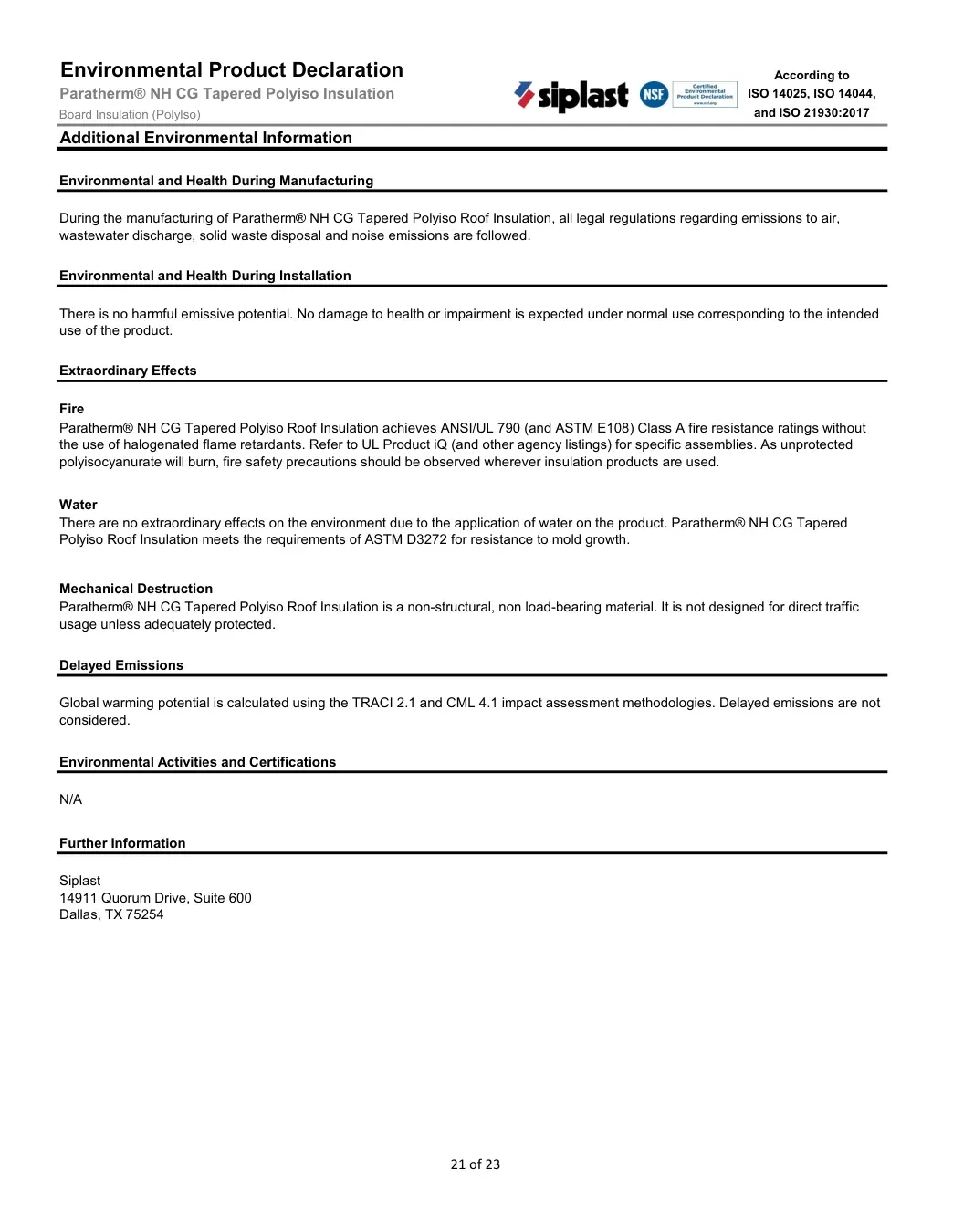
Environmental Product DeclarationBoard Insulation (PolyIso)ISO 14025, ISO 14044,Paratherm® NH CG Tapered Polyiso InsulationAccording toand ISO 21930:2017Environmental and Health During InstallationExtraordinary EffectsSiplast 14911 Quorum Drive, Suite 600Dallas, TX 75254Further InformationN/AEnvironmental Activities and CertificationsGlobal warming potential is calculated using the TRACI 2.1 and CML 4.1 impact assessment methodologies. Delayed emissions are not considered.There is no harmful emissive potential. No damage to health or impairment is expected under normal use corresponding to the intended use of the product.Delayed EmissionsThere are no extraordinary effects on the environment due to the application of water on the product. Paratherm® NH CG Tapered Polyiso Roof Insulation meets the requirements of ASTM D3272 for resistance to mold growth.WaterDuring the manufacturing of Paratherm® NH CG Tapered Polyiso Roof Insulation, all legal regulations regarding emissions to air, wastewater discharge, solid waste disposal and noise emissions are followed.Mechanical DestructionParatherm® NH CG Tapered Polyiso Roof Insulation is a non-structural, non load-bearing material. It is not designed for direct traffic usage unless adequately protected.Paratherm® NH CG Tapered Polyiso Roof Insulation achieves ANSI/UL 790 (and ASTM E108) Class A fire resistance ratings without the use of halogenated flame retardants. Refer to UL Product iQ (and other agency listings) for specific assemblies. As unprotected polyisocyanurate will burn, fire safety precautions should be observed wherever insulation products are used. FireAdditional Environmental InformationEnvironmental and Health During Manufacturing21 of 23
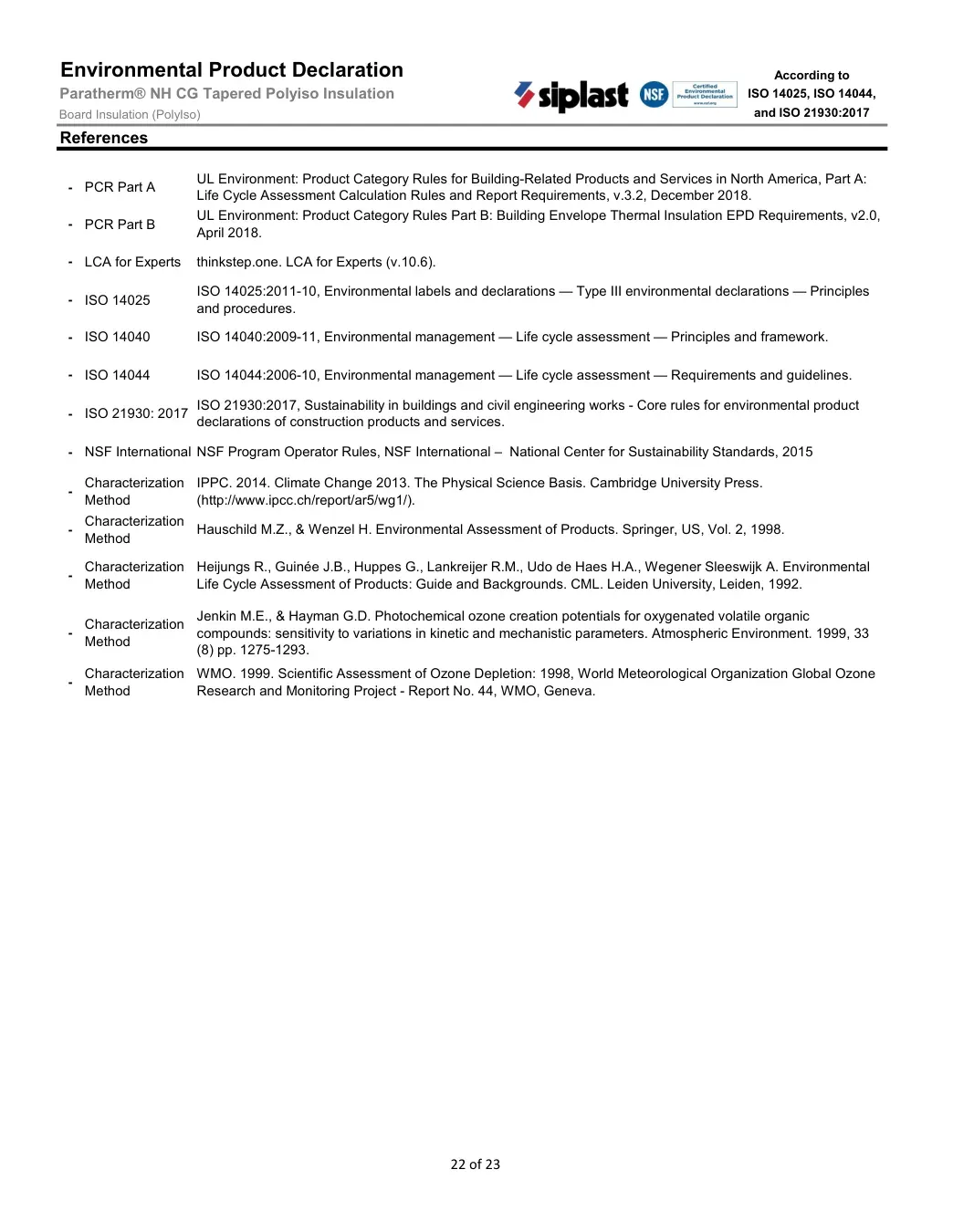
Environmental Product DeclarationBoard Insulation (PolyIso)ISO 14025, ISO 14044,Paratherm® NH CG Tapered Polyiso InsulationAccording toand ISO 21930:2017-ISO 21930:2017, Sustainability in buildings and civil engineering works - Core rules for environmental product declarations of construction products and services.-PCR Part BLCA for ExpertsISO 21930: 2017-ISO 14025:2011-10, Environmental labels and declarations — Type III environmental declarations — Principles and procedures.ISO 14040:2009-11, Environmental management — Life cycle assessment — Principles and framework.ISO 14044--PCR Part AWMO. 1999. Scientific Assessment of Ozone Depletion: 1998, World Meteorological Organization Global Ozone Research and Monitoring Project - Report No. 44, WMO, Geneva.Jenkin M.E., & Hayman G.D. Photochemical ozone creation potentials for oxygenated volatile organic compounds: sensitivity to variations in kinetic and mechanistic parameters. Atmospheric Environment. 1999, 33 (8) pp. 1275-1293.Heijungs R., Guinée J.B., Huppes G., Lankreijer R.M., Udo de Haes H.A., Wegener Sleeswijk A. Environmental Life Cycle Assessment of Products: Guide and Backgrounds. CML. Leiden University, Leiden, 1992.Hauschild M.Z., & Wenzel H. Environmental Assessment of Products. Springer, US, Vol. 2, 1998.IPPC. 2014. Climate Change 2013. The Physical Science Basis. Cambridge University Press. (http://www.ipcc.ch/report/ar5/wg1/).NSF Program Operator Rules, NSF International – National Center for Sustainability Standards, 2015-Characterization MethodUL Environment: Product Category Rules Part B: Building Envelope Thermal Insulation EPD Requirements, v2.0, April 2018.thinkstep.one. LCA for Experts (v.10.6).ISO 14044:2006-10, Environmental management — Life cycle assessment — Requirements and guidelines.ReferencesUL Environment: Product Category Rules for Building-Related Products and Services in North America, Part A: Life Cycle Assessment Calculation Rules and Report Requirements, v.3.2, December 2018.Characterization Method-Characterization MethodCharacterization Method-Characterization Method-ISO 14040---NSF International-ISO 1402522 of 23
Environmental Product DeclarationBoard Insulation (PolyIso)ISO 14025, ISO 14044,Paratherm® NH CG Tapered Polyiso InsulationAccording toand ISO 21930:2017Sustainable Solutions Corporation155 Railroad Plaza, Suite 203Royersford, PA 19468 USA(+1) 610 569-1047info@sustainablesolutionscorporation.com www.sustainablesolutionscorporation.comContact InformationStudy CommissionerLCA PractitionerSiplastJames KirbyCompliance14911 Quorum Drive, Suite 600Dallas, TX 75254james.kirby@siplast.com23 of 23
